
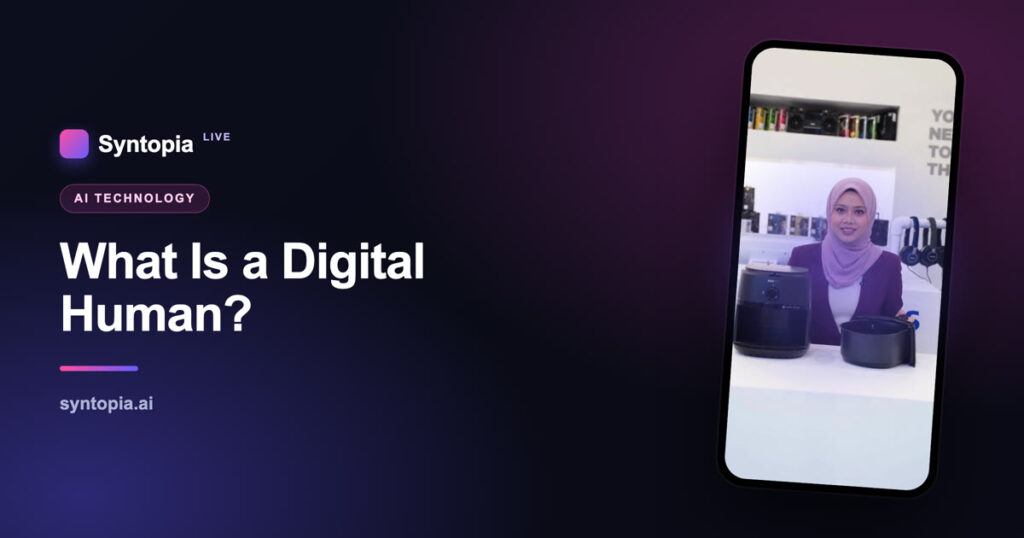
A digital human is a computer-generated, photorealistic virtual person — powered by AI — that can look, speak, move and interact like a real human. Also called an AI digital human or AI avatar, it combines a lifelike visual model, a natural AI voice, and real-time rendering so it can present, converse and react on screen. Digital humans are now used to host live shopping streams, answer customers, front brand content and present 24/7 in any language. This guide explains what a digital human is, how it differs from avatars, deepfakes and VTubers, how one is made, and where digital humans are already being used.
What this guide covers
- What is a digital human?
- Digital human vs AI avatar vs deepfake vs VTuber
- How a digital human is made
- What digital humans are used for
- Digital humans in live commerce
- Consent, disclosure and ethics
- How to create your own digital human
- Frequently asked questions
What is a digital human?
A digital human is a realistic, AI-driven virtual person designed to communicate like a real one. It has three essential layers:
- A photorealistic visual model — a face and body that look convincingly human, either designed from scratch or built from footage of a real person.
- A voice — a natural AI voice, or a voice model created (with consent) from a real person’s speech.
- Real-time intelligence and rendering — the ability to speak a script, lip-sync accurately, and react live, rather than playing a fixed pre-recorded clip.
Put together, a digital human can host a live stream, answer a customer, or present a product as naturally as a person on camera — but without the limits of a human presenter’s time, language or availability. The best modern digital humans are so lifelike that viewers often can’t tell at a glance, which is exactly why hyperrealistic AI avatars have become a turning point for online selling.
Digital human vs AI avatar vs deepfake vs VTuber
These terms overlap and get muddled. Here’s how they actually relate:
| Term | What it means |
|---|---|
| Digital human | A photorealistic, AI-powered virtual person that looks and behaves like a real human. The broadest, most “lifelike” category. |
| AI avatar | Often used interchangeably with digital human. Can also mean a stylised or cartoon on-screen character. In live commerce, “AI avatar” usually means a realistic digital human host. |
| Deepfake | AI that swaps or fabricates a real, specific person’s face or voice — frequently without consent. Deepfakes are about impersonation; a digital human is an owned, disclosed presenter. |
| VTuber | A live streamer represented by an animated (usually anime-style) avatar driven by a real person in real time. Stylised, not photorealistic. |
The key distinction: a digital human you create or license is a legitimate, disclosed presenter you own. A deepfake imitates a real person without rights. Reputable platforms build digital humans with consent and disclosure — not impersonation.
How a digital human is made
- Build the visual model. Either generate a brand-new face and body, or create a likeness from recorded footage of a real person who has given consent.
- Create the voice. Choose a natural AI voice or build a voice model from recordings (again, with consent).
- Connect intelligence. Feed it a script, product knowledge and responses so it knows what to say and how to react.
- Render in real time. A rendering engine animates the face and body live, syncing lips to the audio so it reads as a genuine presenter rather than a video file.
The real-time rendering step is what separates a true digital human from a pre-recorded talking-head video — it’s what lets the digital human go live and interact. For the full live workflow, see how an AI digital-human livestream works.

What digital humans are used for
- Live shopping hosts. Presenting products on TikTok Shop, Shopee and YouTube around the clock — the fastest-growing use by far.
- Brand ambassadors. A consistent virtual face for a brand across content and campaigns.
- Customer service and assistants. Conversational on-screen help that’s available 24/7.
- Content and education. Presenters for tutorials, news-style updates and training in many languages.
- Virtual influencers. AI personalities with their own audiences.
Digital humans in live commerce
Live commerce is where digital humans have found their killer application. Live shopping converts exceptionally well but demands huge streaming hours; a digital human removes that ceiling. It can host a live selling stream for hours, in the local language of each market, at a fraction of the cost of a human rota. This is the engine behind AI live selling — and why brands increasingly run their live channels with a virtual host for the hours no human team can cover.
Consent, disclosure and ethics
Because digital humans can look so real, responsible use matters:
- Consent. If a digital human is based on a real person, that person must agree — ideally with a clear licence covering face and voice.
- Disclosure. Audiences and platforms expect you to signal when a presenter is AI. Transparency builds trust and keeps you compliant.
- No impersonation. Using a real individual’s likeness without permission crosses into deepfake territory and is prohibited on major platforms.
Done right — owned, consented and disclosed — digital humans are a legitimate, powerful tool. Done wrong, they become deception. The difference is entirely in how they’re used.
How to create your own digital human
- Decide the purpose. Live selling, content, support — this shapes the voice, look and script.
- Create or choose the model. A ready-made digital human, or one built from your own consented footage.
- Set the voice and language(s). Pick natural voices for each market you’ll present in.
- Give it knowledge and a script. What it should say, sell and answer.
- Go live with disclosure. Add an on-screen AI label and keep a human in the loop.
Platforms like Syntopia handle the modelling, voice and real-time rendering so you can create a digital human and put it to work in live commerce without building any of the technology yourself. See how it works, or follow the AI live seller tutorial to put a digital human live on TikTok Shop.
Frequently asked questions
What exactly is a digital human?
A digital human is a photorealistic, AI-powered virtual person that can look, speak, move and interact like a real human. It combines a lifelike visual model, a natural voice, and real-time rendering so it can present and converse on screen rather than just play a pre-recorded clip.
Is a digital human the same as an AI avatar?
Mostly yes — the terms are often used interchangeably. “AI avatar” can sometimes mean a stylised character, but in live commerce it usually refers to a realistic digital human host.
What’s the difference between a digital human and a deepfake?
A digital human is an owned, disclosed virtual presenter you create or license. A deepfake imitates a real, specific person’s face or voice — often without consent. The difference is consent, ownership and honesty.
Are digital humans legal to use?
Yes, when you own or license the likeness and voice and disclose that the presenter is AI. Using a real person’s likeness without permission is not permitted on major platforms.
What are digital humans mainly used for?
The biggest use today is hosting live shopping streams. They’re also used as brand ambassadors, customer-service assistants, content presenters and virtual influencers.
Can a digital human speak multiple languages?
Yes. A digital human can present in many languages with native-sounding voices, which is a major advantage for brands selling across different markets.
The takeaway
A digital human is a photorealistic, AI-powered virtual person — and the technology has matured to the point where digital humans now host live shopping streams, front brands and serve customers around the clock, in any language. The difference between a legitimate digital human and a deepfake is consent, ownership and disclosure. Used responsibly, a digital human is one of the most powerful tools in modern commerce. See how digital humans power AI live selling, or explore Syntopia’s platform.
Written by the Syntopia team. Syntopia builds AI digital humans and real-person-driven live selling for TikTok Shop, Shopee, YouTube and more.