

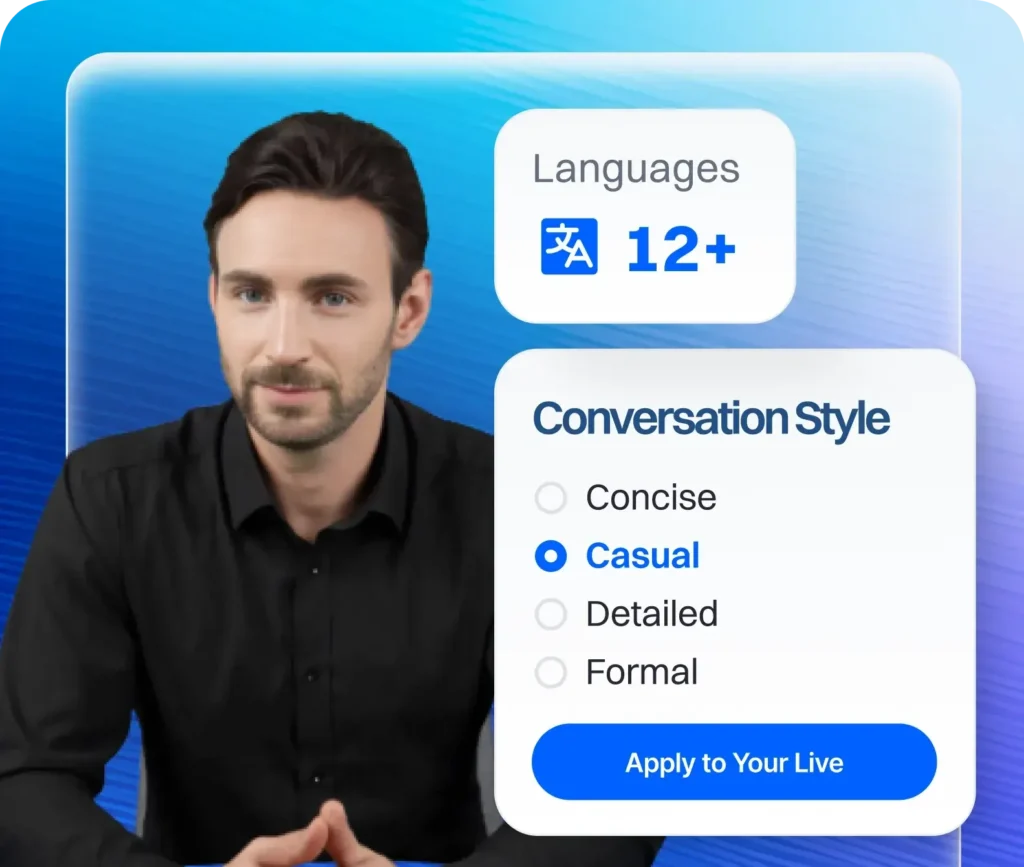
If you are a brand owner or operator looking at TikTok Shop live commerce and trying to understand whether an AI avatar host is the right move — and what that actually looks like in practice — this guide is written specifically for you. Not for developers, not for creators, not for people who want to understand the technology. For the person who needs to know: what does this cost, what do I get, how does it work operationally, and what should I expect?
Syntopia is owned by LiveBuzz Studio — the UK’s number one TikTok Creator Agency Partner (CAP) and a TikTok Shop Partner in both the UK and US. Our team includes ex-TikTok employees. We have built and operated AI avatar live commerce for brands across multiple categories. This guide reflects what we have learned from running it, not just building it.
The Problem This Solves
TikTok Shop live commerce works. The data on this is not ambiguous — TikTok Shop is projected to exceed $20 billion in sales in 2026, live commerce consistently generates 10-15x higher conversion rates than feed content, and the brands running consistent, high-quality live sessions are building compounding algorithmic advantages that become harder for competitors to overcome over time.
The problem is the operational model required to run live commerce at scale. A brand that wants to run daily live sessions covering the time windows that drive maximum reach — morning, lunch, evening — needs live hosts available across those windows every day. Good hosts are expensive. Consistent hosts across long sessions are rarer still. And the session quality that ByteDance’s internal training frameworks identify as the threshold for algorithmic amplification — the deep product analysis, the deal story craft, the energy maintenance across 4-6 hour sessions — is genuinely difficult to sustain with human staff at meaningful frequency.
This is the problem Syntopia solves. Not “can you get an AI avatar for TikTok” — but “can you run a live commerce operation at the frequency, quality, and duration required to build real TikTok Shop momentum without a full-time human hosting team.”
What the AI Avatar Actually Does
Understanding what Syntopia’s AI avatar does in a live session requires understanding what a high-performing human host does — because the AI replicates and extends that capability, not a simplified version of it.
ByteDance’s internal TSP training — the programme that LiveBuzz Studio’s team delivered to UK Seller Partners — defined live commerce hosting around four core pillars. The AI avatar executes all four:
- Deep product analysis: The avatar presents every product assuming the viewer is half-watching and needs to be pulled in through specificity and detail — material, texture, sizing, mechanism, use case. Not a summary. A thorough, engaging breakdown that forces attention.
- Checkout demonstration: Regularly walks viewers through the in-app purchase process — where to tap, what the buttons are called, how long it takes — because a significant proportion of viewers at any given session have never bought inside TikTok before.
- Deal story delivery: For every product, the avatar delivers the story behind the price — why it exists today, what makes this moment different from any other buying opportunity. The “why” that resolves doubt and drives conversion. Not “normally £80, today £20” — the full credible explanation that makes the deal believable.
- Repetition for a rotating audience: Key messages cycle every 5-10 minutes because viewers join mid-session constantly. Someone who joins at minute 45 gets the full pitch, not a continuation of something they missed.
The avatar also reads and responds to live comments in real time — answering product questions, acknowledging purchases, flagging engagement moments. And it maintains identical energy and delivery quality in hour one and hour twelve. The mood variable — which ByteDance’s CN training identified as a direct performance metric because host energy determines room energy which determines conversion rate — is eliminated.
What Onboarding Looks Like
For brand owners evaluating AI avatar live commerce, the onboarding process is one of the first practical questions. Here is what it involves:
| Stage | What Happens | Your Involvement |
|---|---|---|
| Brand briefing | Understanding your product categories, brand voice, target audience, price points, and competitive positioning | Brand consultation session — typically 2-3 hours |
| Avatar configuration | Building your avatar — appearance, voice, communication style, energy level — to match your brand identity | Review and approval of avatar presentation |
| Product scripting | Building the product scripts — detail pitches, deal stories, urgency triggers, checkout demonstration language — for your initial product lineup | Product information, pricing context, deal authorisation |
| Session architecture | Designing the session structure — opening product selection, product order, re-entry hooks, engagement triggers, closing sequence | Product selection approval |
| Test sessions | Running internal test sessions to verify avatar performance, product presentation quality, and technical operation before going live | Review and feedback on test session recordings |
| Live launch | First live session with monitoring and real-time adjustment capability | Available for feedback during and after first session |
What a Week of AI-Hosted Live Commerce Looks Like
For a brand running a standard AI-hosted live commerce operation on TikTok Shop, a typical week looks like this:
Monday through Friday: Daily live sessions at pre-scheduled times — typically morning (7-9am to catch commute viewers), lunch (12-1pm), and evening (8-10pm) for UK markets. Each session runs 2-4 hours. The avatar operates without human supervision required — the system runs the session, responds to comments, and manages the product presentation sequence automatically.
Post-session review: After each session, performance data is available — peak concurrent viewers, average view duration, GMV, conversion rate, comment engagement by product. The brand team reviews this weekly and identifies product rotation changes, script refinements, and session architecture adjustments.
Product updates: When new products are added to the TikTok Shop, product scripts are built and added to the rotation. This is typically a 24-48 hour turnaround for a new product from brief to live-ready script.
Weekend: For brands targeting peak weekend buying windows, Saturday and Sunday sessions can be scheduled with no additional staffing cost — the operational overhead of running a weekend session is identical to running a weekday session.
The Economics: What This Compares To
The commercial case for AI avatar live commerce is most clearly understood by comparison to the human-hosted alternative at equivalent frequency and quality.
| Cost Factor | Human-Hosted (Daily, 3 Sessions) | AI Avatar Hosted |
|---|---|---|
| Host cost | £500-£2,000+ per host per day for professional quality × 3 sessions × 5 days | Fixed platform cost regardless of session frequency |
| Session quality consistency | Varies by host energy, day, length of session | Identical across every session and every hour of each session |
| Scheduling flexibility | Constrained by human availability — mornings, evenings, weekends require premium rates or separate staff | Unlimited — any time, any duration, any frequency |
| Scaling to new markets | New host required for each language/market | Language and market configuration — no additional hire |
| Session duration capability | Practical maximum 4-6 hours at quality before performance degrades | 24 hours continuous at identical quality |
The cost comparison is significant for brands running more than 2-3 sessions per week. At daily frequency across multiple time slots, the economics of human hosting become prohibitive for most brands. AI avatar hosting converts a variable, high, and operationally complex cost into a predictable platform cost.
What Brands Are Best Suited for AI Avatar Live Commerce
Not every brand is at the same stage of TikTok Shop development, and the right entry point for AI avatar live commerce depends on where you are.
| Brand Stage | AI Avatar Live Commerce Fit | Why |
|---|---|---|
| Established TikTok Shop with human-hosted live commerce | Highest fit | You already know live commerce works for your products and audience. AI hosting scales what you have proven without the staffing cost and quality inconsistency. |
| TikTok Shop seller wanting to move from feed content to live | Strong fit | AI hosting removes the largest barrier to starting live commerce — finding, managing, and affording a consistent human host. |
| Brand new to TikTok Shop entirely | Good fit with caveats | The cold start phase (first 15 sessions building algorithmic trust) still applies and requires the same consistency. AI hosting executes this reliably, but product-market fit on TikTok still needs validation. |
| Celebrity or public figure wanting to monetise audience | Specific use case | AI digital twin built in your likeness — your brand, your voice, your audience, without requiring your personal time. See the For Celebrities page. |
| Influencer wanting to scale reach | Specific use case | Extend your live commerce presence beyond what your schedule allows without being on camera constantly. See the For Influencers page. |
The TikTok Algorithm and AI-Hosted Sessions
A common question from brand owners is whether TikTok’s algorithm treats AI-hosted sessions differently from human-hosted sessions. The answer is no — the algorithm evaluates engagement signals, not the identity of the host. Comment volume, share rate, follow rate, concurrent viewer count, session duration, and conversion rate are what the algorithm weights. A session that generates strong engagement signals from an AI avatar gets the same algorithmic amplification as a session that generates the same signals from a human host.
The practical advantage of AI hosting from an algorithmic standpoint is consistency of signal quality across sessions. Human-hosted sessions produce variable engagement signals — good sessions, average sessions, and weak sessions depending on host performance, product lineup, and timing. AI-hosted sessions produce more consistent signals because the hosting quality variable is controlled. Over time, consistent positive signals build stronger algorithmic trust than a pattern of variable performance.
What to Expect — Realistic Timeline
Brand owners evaluating AI avatar live commerce reasonably want to know what the performance trajectory looks like. Based on the ByteDance cold start framework and real operational experience:
- Sessions 1-3 (Cold Start Icebreaker): Algorithm is establishing your account as a consistent broadcaster. Session reach will be limited. Focus on consistency, not scale.
- Sessions 4-7 (Climbing Period): First meaningful engagement signals should be appearing. Comment volume increasing, first organic reach expansion. Optimise product selection based on commodity analysis data from sessions 1-3.
- Sessions 8-15 (Stable Growth): Algorithmic trust is building. You should have enough session data to identify your hero products, optimal time slots, and highest-converting product positions. This is the phase where refinement based on data produces significant performance improvements.
- Month 2-3: Accounts that have maintained quality and consistency through the cold start typically start seeing meaningful GMV in this window. The compounding nature of algorithmic trust means performance improvement accelerates rather than plateaus at this stage.
These timelines are consistent with the ByteDance cold start framework — for more detail on each phase, read the complete cold start guide.
Next Steps
If you are a brand owner evaluating AI avatar live commerce for TikTok Shop, the most useful next step is a conversation about your specific situation — your product category, your current TikTok presence, your commercial objectives, and what a realistic implementation looks like for your brand.
See Syntopia’s pricing for the commercial structure, or the For Business page for more detail on what brand-level implementation looks like. To discuss your specific situation, book a demo with the LiveBuzz Studio team.
Frequently Asked Questions
Does the AI avatar look and sound like a real person?
Syntopia builds hyperrealistic AI avatars — the technology uses advanced rendering and natural language synthesis to create a presenter that looks and sounds natural in a live stream context. Most viewers do not identify AI avatars as non-human in a live commerce setting, and in markets where AI-hosted live commerce is already mainstream (China’s live commerce market), audiences have come to accept and in many cases prefer the consistency they deliver.
Can the AI avatar use our brand’s existing personality and voice?
Yes — avatar configuration includes matching communication style, energy level, and brand voice to your existing brand identity. For brands or individuals who want an avatar built in a real person’s likeness (a celebrity, founder, or brand ambassador), Syntopia also builds AI digital twins from the individual’s video and voice data.
What happens if a viewer asks a question the avatar does not know the answer to?
The avatar’s knowledge base covers the products in your session, checkout process, brand information, and common objection handling. For questions outside this scope, the avatar is configured to handle gracefully — directing the viewer to your customer service channel or acknowledging the limit honestly. This is preferable to a human host guessing an answer that turns out to be wrong.
How quickly can we get started?
From initial brief to first live session is typically 2-4 weeks for a standard brand onboarding. Complex onboardings — multiple product categories, multilingual requirements, digital twin builds — take longer. The limiting factor is usually the time required to build and refine product scripts to the quality level needed for live commerce performance, not the technical setup.
Does this work for brands in both the UK and US markets?
Yes — Syntopia operates as a TikTok Shop Partner in both the UK and US markets. TikTok Shop’s live commerce infrastructure is consistent across both markets. The primary differences between UK and US operations are timing (peak viewer windows differ by time zone) and in some cases product compliance requirements, both of which are addressed in the onboarding process.
Related Reading: