

If you have been researching a HeyGen alternative for TikTok Shop live commerce and HeyGen keeps coming up as the obvious answer, this post will save you a significant amount of time and money. HeyGen is an excellent product — but it is built for a completely different use case than TikTok Shop live commerce. Understanding the difference is not a minor technical distinction. It determines whether the technology you invest in will actually solve your problem.
Syntopia is owned by LiveBuzz Studio — the UK’s number one TikTok Creator Agency Partner (CAP) and a TikTok Shop Partner in both the UK and US. Our team includes ex-TikTok employees. We are not speculating about how these platforms compare — we operate in TikTok Shop live commerce daily and understand exactly where HeyGen ends and where Syntopia begins.
The Core Distinction: Recorded vs Real-Time
HeyGen is a video production platform. You provide a script, select an avatar, and HeyGen generates a polished video that you then publish. The process is asynchronous — you create the video, it renders, you review it, you post it. The avatar does not interact with anyone. It delivers a pre-written script into a recording that becomes a finished asset.
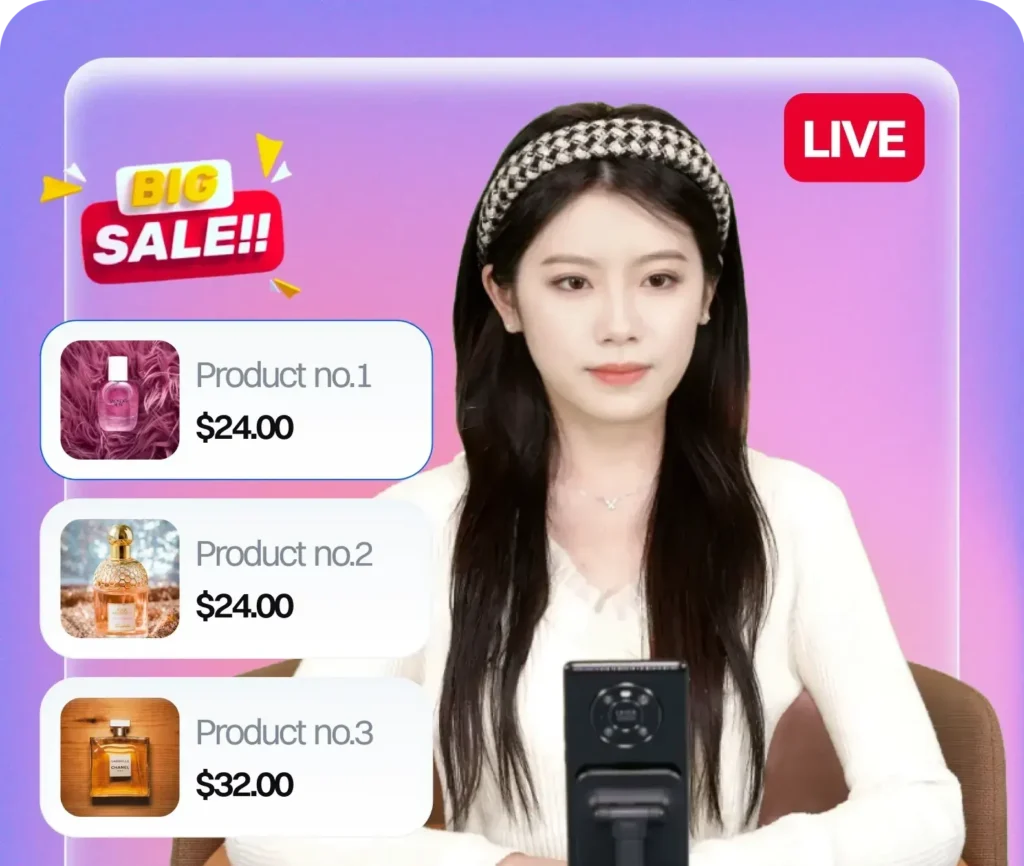
Syntopia is a live commerce platform. The avatar hosts a TikTok Shop live stream in real time — responding to viewer comments as they appear, adapting the pitch to what is happening in the room, demonstrating the checkout process, managing the energy of the session across hours of continuous operation. Nobody records anything in advance. The avatar is live, interactive, and selling.
These are not two versions of the same thing at different price points. They are fundamentally different products solving fundamentally different problems. Using HeyGen for TikTok Shop live commerce is like using a photography studio to film a live news broadcast — the equipment category is adjacent but the application is entirely wrong.
| Capability | HeyGen | Syntopia |
|---|---|---|
| Use case | Pre-recorded video content — marketing videos, explainers, product demos | Real-time TikTok Shop live commerce hosting |
| Viewer interaction | None — video plays, viewers watch passively | Full real-time response to live comments, questions, and purchasing signals |
| Session length | Typically 1-5 minute videos | Hours of continuous live streaming — 4, 8, 12, 24 hours |
| TikTok Shop integration | Creates content for TikTok feed — not live commerce | Purpose-built for TikTok Shop live stream hosting with product pinning |
| Script delivery | Pre-written script rendered once | Dynamic, responsive — adapts to what’s happening in the live room |
| Commerce capability | None direct — video can link to product but avatar does not sell | Active live selling — urgency triggers, deal stories, checkout demonstrations |
| 24/7 operation | Videos can be posted anytime, but production is manual | AI avatar streams continuously without human scheduling or fatigue |
What TikTok Shop Live Commerce Actually Requires
To understand why HeyGen cannot solve the TikTok Shop live commerce problem, you need to understand what the problem actually is. ByteDance’s internal TSP training — the programme delivered to UK Seller Partners by LiveBuzz Studio’s team — built the entire live commerce framework around four presenting pillars that require something pre-recorded video can never deliver: real-time responsiveness.
The first pillar — over-analysing products in depth — works in live commerce because the host can respond to the audience’s confusion, questions, and reactions as they happen. When a viewer drops a comment asking about sizing, the host addresses it immediately and the entire room benefits from that answer. A pre-recorded video cannot do this.
The second pillar — demonstrating how to shop — requires showing the actual checkout process in real time, while viewers are watching and potentially buying. A video can show this once, but a live host can pause, wait for viewers to act, respond to questions about the process, and repeat the demonstration for every new wave of viewers that joins.
The third pillar — the deal story — is most powerful when it is delivered with live urgency. “We have 23 units left and that number is updating in real time as people add to cart” is only true in a live session. In a video, it is a fabrication. Viewers know this. The credibility that makes deal stories convert depends on them being live and verifiable.
The fourth pillar — repetition for a rotating audience — only makes sense in a live context. Pre-recorded video has a defined beginning and end. Live sessions have a constant stream of new joiners who need to be caught up. The entire repetition architecture of effective live commerce depends on the session being live.
The Algorithm Difference: Why This Matters for Reach
TikTok’s algorithm treats live content and recorded video content differently — not as a policy preference but as a fundamental architecture difference. Live streams are evaluated in real time based on engagement signals: comment volume, share rate, follow rate, concurrent viewer count, and session duration. These signals determine whether the algorithm amplifies the stream to a larger audience while it is still live.
A HeyGen-generated video posted to TikTok gets evaluated the same way any pre-recorded video does: by view completion rate, shares, comments after posting, and save rate. These are good signals for building a content following. They are completely disconnected from the live commerce conversion engine TikTok has built.
Running TikTok Shop live commerce with pre-recorded avatar content is not just suboptimal — it violates TikTok’s live commerce policies. A “live” stream that is actually playing recorded content is a terms-of-service violation that can result in account penalties. The algorithm is designed to detect and penalise this. Syntopia’s technology is built for genuine real-time interaction precisely because that is the only approach that works within TikTok’s framework and generates the algorithmic signals that drive reach.
Where HeyGen Is Genuinely Excellent
This is not a criticism of HeyGen. For what it is designed to do, HeyGen is a highly capable product. If your goal is to produce polished marketing videos at scale — product explainers, brand content, educational material, social media posts — HeyGen’s avatar and voice synthesis technology is strong and the production workflow is efficient.
HeyGen is also a legitimate tool for TikTok content — specifically for the short-form videos that appear in the feed, not in live sessions. If you want to create product showcase videos with an AI presenter for your TikTok feed, HeyGen can do that. That content can support your live commerce operation by building audience awareness before a live session.
The problem arises when sellers conflate “AI avatar video” with “AI avatar live commerce host.” They are different product categories and the distinction has significant commercial consequences.
The Live Commerce Performance Gap in Practice
In June 2025, a TikTok Shop AI avatar live stream generated $7.65 million in revenue in seven hours. That event was possible because of real-time interaction — the avatar responded to viewer comments, adjusted its pitch, demonstrated the checkout process, and maintained selling energy continuously for the full session. None of that is replicable with pre-recorded content of any kind.
ByteDance’s CN TSP training identified host mood as an explicit performance metric — host energy determines room energy, room energy determines conversion rate. This insight is only meaningful in a live context where the host’s energy is a real-time variable. In a pre-recorded video, “host mood” is a production decision made before filming. In live commerce, it is a dynamic that unfolds in real time and responds to the room.
Syntopia’s AI avatar maintains consistent energy across hours of live operation — the mood variable is eliminated, but only because the avatar is genuinely live. A recorded video playing on a loop in a “live” session would have the same energy from a technical standpoint, but it would be violating platform policy, failing to interact with viewers, and missing every conversion opportunity that live interaction creates.
What to Use When
| Goal | Right Tool | Why |
|---|---|---|
| Create polished product explainer videos for your TikTok feed | HeyGen | Asynchronous video production is exactly what HeyGen is built for |
| Run TikTok Shop live streams with an AI host that responds to viewers | Syntopia | Real-time interaction, live commerce architecture, 24/7 operation |
| Scale TikTok content production without being on camera | HeyGen for feed content + Syntopia for live | Both serve different parts of the TikTok commerce ecosystem |
| Run 24/7 TikTok Shop live commerce without human staffing costs | Syntopia | HeyGen has no live commerce capability |
| Build brand awareness through AI-presented social content | HeyGen | Feed videos don’t require real-time interaction |
| Convert TikTok viewers into buyers through live selling | Syntopia | Conversion in live commerce happens through interaction, urgency, and real-time deal stories |
The Live Commerce Technology Stack in 2026
The most sophisticated TikTok Shop operations in the UK and US are not choosing between HeyGen and Syntopia — they are using both as part of a complete content strategy. HeyGen (or similar tools) for feed content that builds audience and drives traffic into live sessions. Syntopia for the live sessions themselves, running the full ByteDance 4-pillar framework continuously without human hosting costs or scheduling constraints.
This stack treats TikTok commerce as what it is: a dual-channel system where feed content drives discovery and live commerce drives conversion. The two channels have different requirements, and the tools that serve them best are different by design.
If you are evaluating AI avatar technology for TikTok Shop and the question is specifically about live commerce hosting — running streams that interact with viewers, build urgency, demonstrate checkout, and sell products in real time across long sessions — Syntopia is built for that specific problem. HeyGen is not.
Frequently Asked Questions
Can HeyGen be used for TikTok Shop live commerce?
No — not effectively and not within TikTok’s terms of service for live content. HeyGen creates pre-recorded videos. Playing pre-recorded content in a TikTok “live” session violates platform policy and fails to generate the real-time engagement signals that drive algorithmic reach in live commerce. HeyGen is excellent for TikTok feed content but has no live commerce capability.
What is the main difference between HeyGen and Syntopia?
HeyGen is a video production tool — you create a script, it generates a video, you publish it. Syntopia is a live commerce hosting platform — the AI avatar hosts a TikTok Shop live stream in real time, responding to viewer comments, managing urgency triggers, demonstrating checkout, and selling continuously across hours of operation. Different product categories, different use cases, different results.
Does Syntopia compete with HeyGen?
Only at the surface level of “both involve AI avatars.” The actual use cases do not overlap. Sellers often search for HeyGen alternatives when they are trying to solve the TikTok Shop live commerce problem — but HeyGen was never designed for that problem. Syntopia is specifically built for live commerce and does not compete in the pre-recorded video production space where HeyGen operates.
Can I use both HeyGen and Syntopia together?
Yes — and this is the approach that makes most sense for brands running a complete TikTok Shop operation. HeyGen for feed content that builds audience and drives traffic into live sessions. Syntopia for the live sessions themselves. The two tools serve different parts of the TikTok commerce ecosystem and work well together as part of a complete strategy.
What makes Syntopia specifically suited for TikTok Shop live commerce?
Syntopia is built around the operational requirements of TikTok Shop live commerce: real-time comment interaction, product pinning synchronisation, the ByteDance 4-pillar presenting framework, deal story delivery with live urgency triggers, checkout demonstrations, and continuous operation across long sessions without energy decline. These capabilities are purpose-built for live commerce — they do not exist in video production tools like HeyGen because video production does not require them.
Related Reading: