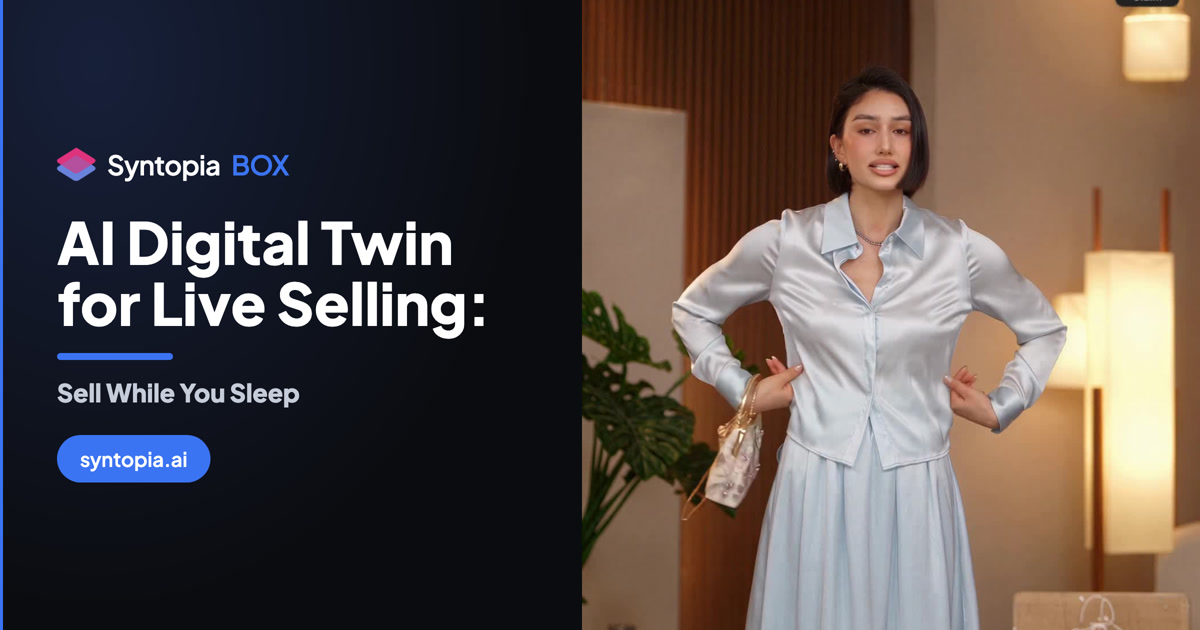
An AI digital twin for live selling is an AI avatar modelled on one specific real person — you — that goes live, pitches your products and answers the chat on its own. It carries your face and your cloned voice, but it is a synthetic host, so it can run while you sleep.

If you have ever wished you could build a digital twin to sell for you around the clock — on TikTok Shop, Shopee, YouTube and more — this is the plain-English explainer: what a digital twin actually is, how it differs from a generic stock avatar, and how Syntopia BOX builds one from a short video of you.
This is the concept piece. When you are ready to set it up click by click, the Syntopia BOX complete guide walks the whole thing from a blank PC to your first live stream.
- A digital twin is an AI avatar of a specific person — your look plus a cloned voice — not a generic presenter picked from a library.
- Because it is AI, your twin sells 24/7: it welcomes viewers, follows your script, and answers the chat from a knowledge base without you on camera.
- Syntopia BOX builds your twin from a short training video, then you clone its voice; to sell in another language you record a short sample in that language and train a V10 voice on it. V10 supports 600+ languages, with the common ones pre-loaded. Avatar cloning is included in every plan.
- Your twin is clearly AI. When you want a real person on camera, that is a separate mode (Human Takeover) — a real human, not the twin.
- One twin can run in many rooms at once — scaling with the PCs and Syntopia BOX accounts behind it.
What is an AI digital twin for live selling?
Most “AI avatar” tools hand you a presenter: a good-looking stock face from a library that reads whatever script you give it. A digital twin is different. It is an AI digital human trained on you — your appearance and your voice — so the host on screen looks and sounds like the real seller behind the brand.
For live selling, that distinction matters. Shoppers buy from people they recognise. A digital twin lets your audience see the familiar face and hear the familiar voice they already trust, on a stream that never has to end. You record once; the twin does the shift.
Under the hood it is still an AI avatar — a synthetic host, not literally you — and it should always be presented that way. What makes it a twin rather than a generic avatar is that it is modelled on a specific real person instead of a library character.
Digital twin vs. a generic AI avatar
Both are AI hosts. The difference is whose face and voice they carry, and how well that fits a brand that sells live every day.
| What matters for live selling | Generic stock avatar | Your digital twin |
|---|---|---|
| Who it looks like | A library presenter many other sellers also use | You — modelled from your own training video |
| The voice | A stock voice, or a separate upsell | Your own cloned voice; V10 supports 600+ languages (train a voice per market) |
| Brand recognition | Generic; viewers won’t connect it to you | The face and voice your audience already knows |
| Can it hold & show your products | Varies by tool | Yes — holds products and wears items up close |
| Sells while you sleep | Yes (it’s AI) | Yes (it’s AI) |
| Setup cost of the likeness | Often per-avatar fees | Avatar cloning included in every Syntopia plan |
9.6
6.8
4.5
3.5
How Syntopia BOX builds your digital twin
Syntopia BOX is an on-premise Windows application you install and run on your own PC. It builds your twin from three things — a look, a voice and a brain — then pipes that host’s picture and voice straight into your live-streaming app. Here is the overview; the complete guide has every click.
The look — train from a short video
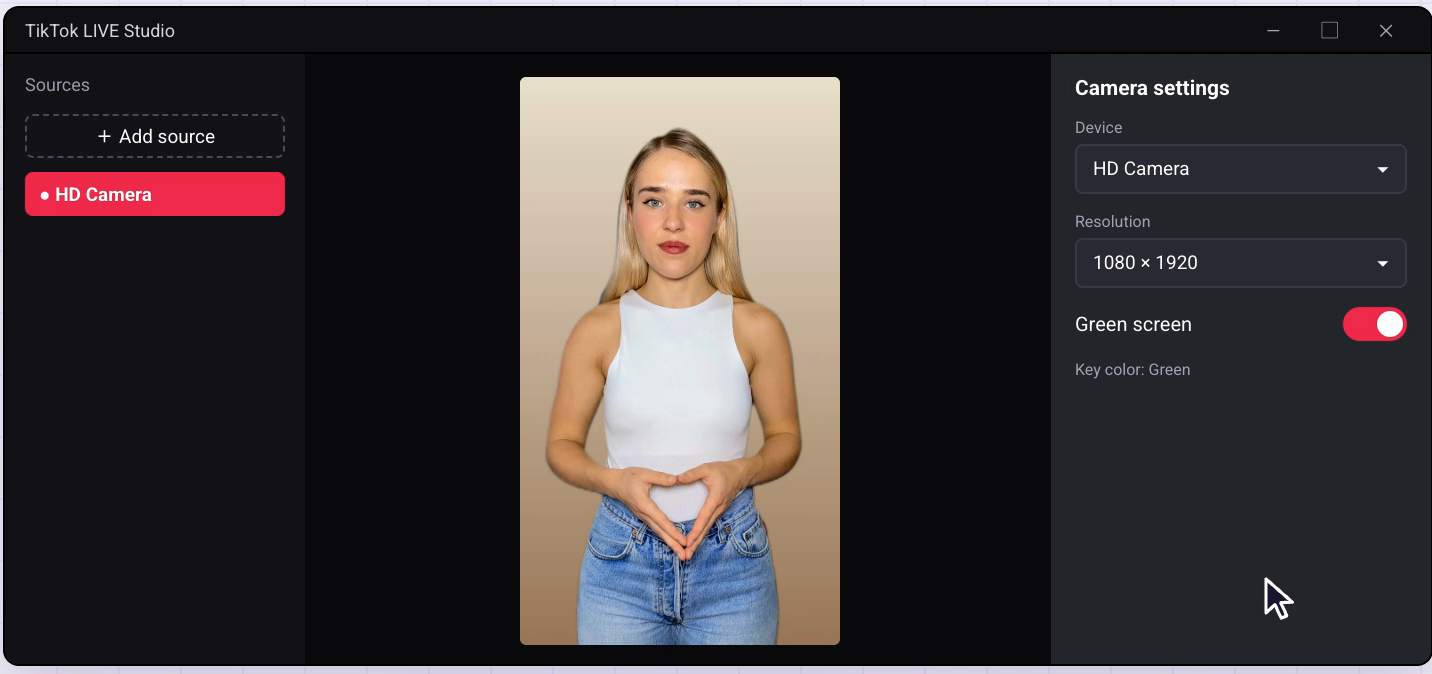
Upload a short video of yourself and BOX trains an AI digital human from it. Pick a V5 look for the quickest setup. The result is an avatar model of you that moves like a real person — it can turn to the side, sip water, step out of frame and back, and hold a product up close to the camera. For the most faithful result, film in the same lighting and distance you will go live in.
The voice — clone it once
A few seconds of clear audio is enough to clone a voice, or you can use a ready-made one. There are two voice families: V6 (tuned mainly for English) and V10 (English too, but built for foreign-language voices). V10 supports 600+ languages, and the most-used ones are already loaded when you set up a stream. To sell in Brazilian Portuguese, Korean, Vietnamese, Thai or across Europe, you record a short sample in that language, train a V10 voice on it and write your script in that language — so your twin speaks it live, in your own voice. If a language isn’t pre-loaded, translate your content and paste it, or request it be added. Voice cloning is included and never expires.
The brain — connect an AI model
So your twin can actually answer questions, connect an AI model: paste your API key from a provider such as OpenAI or DeepSeek. That is the brain that writes and rewrites scripts so nothing repeats, and answers the chat in real time. Your twin reads comments and replies on its own.
How your digital twin sells 24/7
A twin that just reads a loop would get flagged and ignored. What makes it sell while you sleep is the live-room layer around it — the same engine that powers a hands-off Syntopia stream:
- Proactive Live Chat — welcomes new viewers, asks for follows and likes, and nudges people to buy, on its own.
- Smart Live Chat — an LLM answers chat questions in real time from a custom knowledge base of up to 20,000 characters (prices, sizes, shipping, returns). The better your knowledge base, the better the answers.
- Segmented Variation — your script is rewritten into many versions so no two runs are identical, which keeps a round-the-clock stream looking live rather than looped.
- A second voice (assistant) and co-host mode — a second voice or digital human can join your twin so they sell together.
- Shift changes & teams — schedule a new host in a new outfit to take over on time, or build a whole team of avatars, each with a different voice.
You record once. Your twin does the shift — greeting, pitching and answering — while you sleep.
Where your twin can sell
Your digital twin streams to TikTok Shop, Shopee and YouTube, plus 11 more platforms, with product pop-ups, dynamic scenes and built-in risk checks on every stream. It is one of five ways to go live in BOX — the digital-human host being the one that uses your twin. The others (real-scene camera, smart recorded, AI hosting assistant and video live stream) change where the picture comes from; the complete guide covers all five.
Is it still me on the stream?
No — and that is the honest answer to give your viewers. Your digital twin is an AI avatar. It should be disclosed as AI, and Syntopia streams keep that disclosure in place.
When you do want the real you on camera, that is a separate mode called Human Takeover: a real person sits in front of the camera and viewers see the real you, while BOX drives the lip-sync to the script or the AI’s answers. That mode is a real human, not the twin — a useful distinction to keep clear both for your audience and for yourself.
Scaling: one twin, many rooms
A single PC runs a single live room. To run more rooms at once — the same twin selling in several places, or a team of twins — you add more PCs and more Syntopia BOX accounts, one account and livestream slot per concurrent room. There is no hard cap: it scales to a handful, dozens, or hundreds of simultaneous rooms, limited only by the PCs and accounts you put behind it. For the full plan line-up, see the Syntopia pricing page.
What a digital twin costs vs. a human host
A professional live host can cost on the order of $100–200 an hour — and still needs to sleep, so a single person cannot cover a 24/7 schedule. A digital twin runs on Syntopia BOX from about $2.26 an hour on the Starter plan and never clocks off. Avatar cloning, which used to cost $1,380 per avatar, is now included in every plan. Confirm current plans and hours on the pricing page.
Frequently asked questions
What is an AI digital twin for live selling?
It is an AI avatar modelled on one specific real person — your look plus a cloned voice — that goes live, pitches your products and answers the chat on its own. Because it is a synthetic AI host rather than a live person, it can keep selling 24/7 while you are away.
How is a digital twin different from a generic AI avatar?
A generic avatar is a stock presenter from a library that many sellers share. A digital twin is trained on you, so the host carries your face and your voice — the recognition your audience already has with you. Both are AI; only the twin is modelled on a specific real person.
Can my digital twin really sell while I sleep?
Yes. Once it is built, Proactive Live Chat welcomes viewers and nudges them to buy, Smart Live Chat answers questions in real time from your knowledge base, and Segmented Variation keeps the script fresh so the stream stays lively. You can also schedule shift changes so a new host takes over on time.
Is it still me on the stream?
No — your twin is an AI avatar and should be disclosed as AI. If you want the real you on camera, use Human Takeover: a real person sits in front of the camera and BOX drives the lip-sync to the script. That mode is a real human, not the AI twin.
How many digital twins or rooms can I run at once?
One PC runs one live room. To run more at the same time you add more PCs and more Syntopia BOX accounts — one account and slot per concurrent room. There is no hard limit; it scales to dozens or even hundreds of rooms, bounded only by the PCs and accounts behind it.
How much does a digital twin cost compared with a human host?
A professional live host can cost around $100–200 an hour and cannot work 24/7. A digital twin on Syntopia BOX runs from about $2.26 an hour on the Starter plan and never clocks off, with avatar cloning included in every plan. Check the pricing page for current plans and hours.