

Syntopia BOX Guide
When the host is AI, the team does not disappear — it changes shape. This guide maps the team around AI live selling: the new leverage roles, the on-camera rotation you no longer need, and how a small crew keeps many AI live host rooms selling around the clock.

- Four leverage roles replace the on-camera rotation: operator, scriptwriter, moderator and analyst.
- On-camera talent rotation drops away — you manage a system, not presenters’ availability.
- One operator supervises many rooms by exception, backed by smart live chat answering routine comments.
- AI hosts cover the hours; light rotating human shifts cover the exceptions for true 24/7.
- Cost per room falls as you add rooms, because a steady small crew’s work covers every room at once.
When the host is AI, the team does not disappear — it changes shape. The people who used to take turns on camera move to roles that scale far better: running the rooms, writing the scripts, moderating the comments, reading the numbers. This guide maps the team around AI live selling: the new roles, the ones you no longer need, and how a small human crew keeps many AI-host rooms selling around the clock.
The new roles when the host is AI
Four jobs replace the on-camera rotation, and one person can often hold more than one at a small scale:
- Operator — keeps the rooms running, watches the wall, restarts and troubleshoots. The air-traffic controller of the operation.
- Scriptwriter — builds and rotates the script blocks so each room stays fresh and compliant.
- Moderator — owns comment quality and the escalation path, backed by smart live chat.
- Analyst — reads the analytics, runs the tests, decides what becomes default.
These are leverage roles: each one improves every room at once, which is the opposite of a human host whose effort only ever covers their own stream.
What you no longer need
The thing that drops away is on-camera talent rotation — the scheduling, the sick days, the hunt for presenters who can hold a camera for hours, the renegotiation when your best host leaves. You are not managing performers’ availability anymore; you are managing a system. That is the structural saving, and it is worth being honest about it: fewer people are needed on camera, but the remaining roles are more skilled and more durable than a rota of presenters.
One operator across many rooms
The economics turn on this: a single operator can supervise many rooms because the AI hosts do the selling and smart live chat answers the routine comments. The operator works by exception — the quiet room, the off-pace stream, the one that needs a hand — rather than performing. This is the same structure agencies use to run many clients, and it is what lets a solo seller punch far above their headcount.
Shift coverage for 24/7
AI hosts cover the hours; humans cover the exceptions in shifts. You do not need someone on camera overnight — you need someone reachable who can glance at the wall and step in if a room needs it. Light, rotating human shifts over always-on AI rooms is how you get genuine 24/7 coverage without a night-shift presenter. The division of labour between the AI hosts and the humans monitoring them is covered in AI host teams and shift changes.
Handing off to a human mid-stream
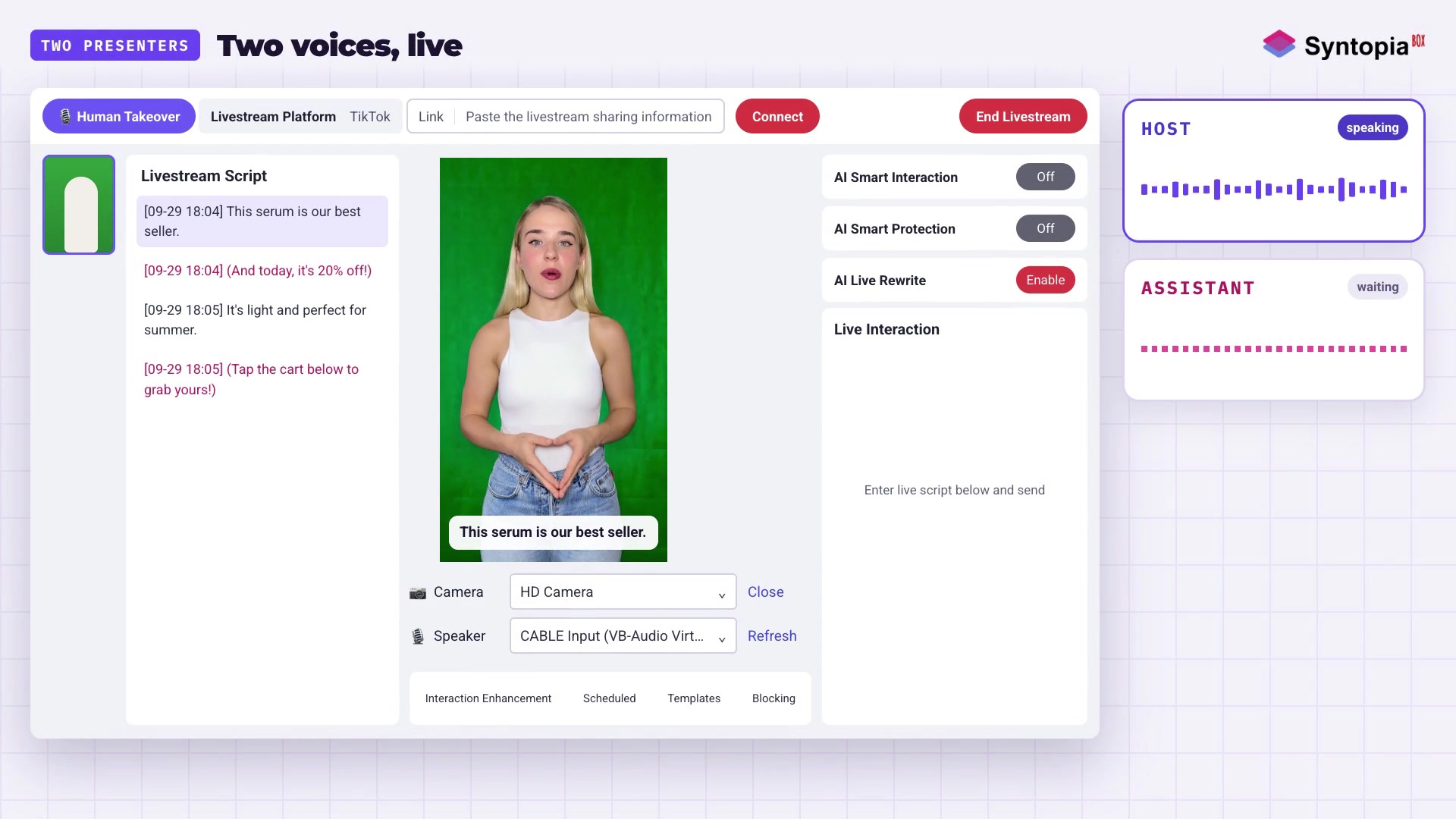
Every team needs a clean takeover path. When a room hits something the AI should not handle — a high-value negotiation, an upset customer, a sensitive question — a human steps into that specific room and the rest keep running untouched. Human takeover is the mechanism; the team practice is deciding in advance who covers which rooms and what triggers a handoff, so it happens in seconds rather than being improvised.
Reporting and iteration workflow
Close the loop weekly. The analyst reports what the numbers say, the scriptwriter updates the blocks, the operator adjusts the schedule, and the next week’s rooms are measurably better. This cadence — measure, change one thing, measure again — is what turns a team from firefighters into an operation that compounds. The A/B testing method is the engine; the team workflow is what makes sure wins actually get adopted.
Hiring vs AI: the honest math
The comparison is not “AI instead of people” — it is a different shape of team. Instead of scaling headcount linearly with rooms (one presenter per stream), you scale rooms with hardware and hold a small, skilled crew steady. The honest version: you still pay for operators, writers and analysts, but their work covers every room at once, so cost per room falls as you add rooms. For where the money actually goes, see how much AI live selling costs; for whether a real person is still needed on camera, see do you need a real person.
A small team, many rooms
Frequently asked questions
What team do you need to run AI live hosts?
A small, skilled crew rather than a rota of presenters: an operator to keep rooms running, a scriptwriter to build and rotate scripts, a moderator for comment quality, and an analyst to read the numbers and run tests. At small scale one person can hold several of these roles.
Can one person run multiple AI live rooms?
Yes. Because the AI hosts do the selling and smart live chat answers routine comments, a single operator supervises many rooms by exception — stepping into the quiet or off-pace room rather than performing. This is how solo sellers and agencies run far more rooms than their headcount suggests.
Do I still need people for 24/7 coverage?
You need people reachable in light rotating shifts, not presenters on camera overnight. The AI hosts cover the hours; humans cover the exceptions — glancing at the wall and stepping into any room that needs a hand. That is how you get genuine round-the-clock coverage without a night-shift host.
How does handing off to a human work mid-stream?
A human takes over one specific room when it hits something the AI should not handle — a high-value negotiation, an upset customer or a sensitive question — while the other rooms keep running. The team decides in advance who covers which rooms and what triggers a handoff so it happens in seconds.
Is an AI-host team cheaper than hiring presenters?
It is a different shape of cost. Instead of adding a presenter per stream, you scale rooms with hardware and hold a small crew steady, so their work covers every room at once and cost per room falls as you add rooms. You still pay operators, writers and analysts, but you stop scaling headcount linearly with streams.