

Do you need a real person for AI live selling? Not on camera, and not for every hour — but a human is always involved somewhere. With Syntopia BOX you can run a fully-scripted stream where the AI host presents and answers comments on its own, or a real-person-driven stream where an actual human drives live and the AI only handles lip-sync and voice. You never need someone performing on camera around the clock; you do need a person to set up, supervise, and — when you choose — take over. This guide explains exactly where the human fits.
What “real-person driving” actually means
This phrase causes more confusion than any other in AI live selling, so let’s be precise. “Real-person driving” means a genuine human controls the stream in real time — they speak, decide what to say, and react to the room — while the AI does nothing more than synchronise the avatar’s mouth and voice to that human. The AI is not inventing the sale. The person is driving; the AI is the face and the voice.
That is categorically different from a fully-scripted AI stream, where the AI host reads a script you prepared and answers the chat by itself. Both are legitimate ways to run a room; they just differ in who is in control moment to moment.
It is worth stressing what the AI is not doing in a human-driven stream. It is not deciding the price, not improvising the pitch, and not choosing how to handle a tricky question — a person is doing all of that in the moment. The avatar simply gives that person a consistent on-camera presence and voice. For many sellers this is the reassuring answer to the “is a machine selling to my customers?” worry: in this mode, no — a human is, through a face the AI renders.
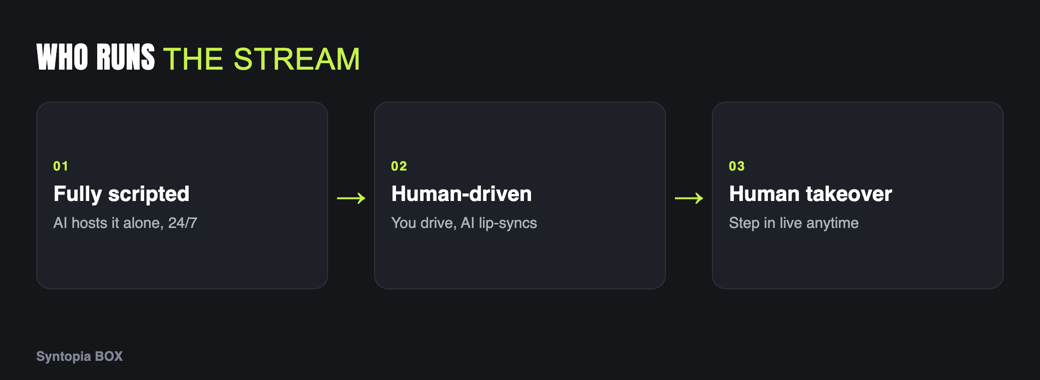
In a human-driven stream, a real human drives and the AI only lip-syncs. The sale is still being made by a person — the AI is the presenter, not the decision-maker.
Fully-scripted vs human-driven modes
It helps to see the two side by side.
| Aspect | Fully-scripted AI stream | Real-person-driven stream |
|---|---|---|
| Who is in control | The AI, from your prepared script | A real human, live |
| What the AI does | Presents and answers comments on its own | Lip-sync and voice only |
| Best for | Long hours, nights, many rooms | Launches, high-touch moments, improvisation |
| Human needed on camera | No — set up and monitor | Yes — driving live (off-camera, through the avatar) |
You are not locked into one. A common pattern is to run scripted streams for the bulk of your coverage and switch a human in for the moments that benefit from a live touch. For the difference between presenting modes in BOX, see standard mode vs AI stream mode.
When platforms expect a human in the loop
Even when an AI host is doing the presenting, some platforms expect a human to be reachable or involved, and these expectations change over time. Treat it as a per-platform question and check the current rules before you rely on fully unattended streams — for example, start with whether AI live selling is allowed on TikTok Shop. The safe operating posture is to always keep a human able to step in, which BOX supports directly.
Human takeover mid-stream
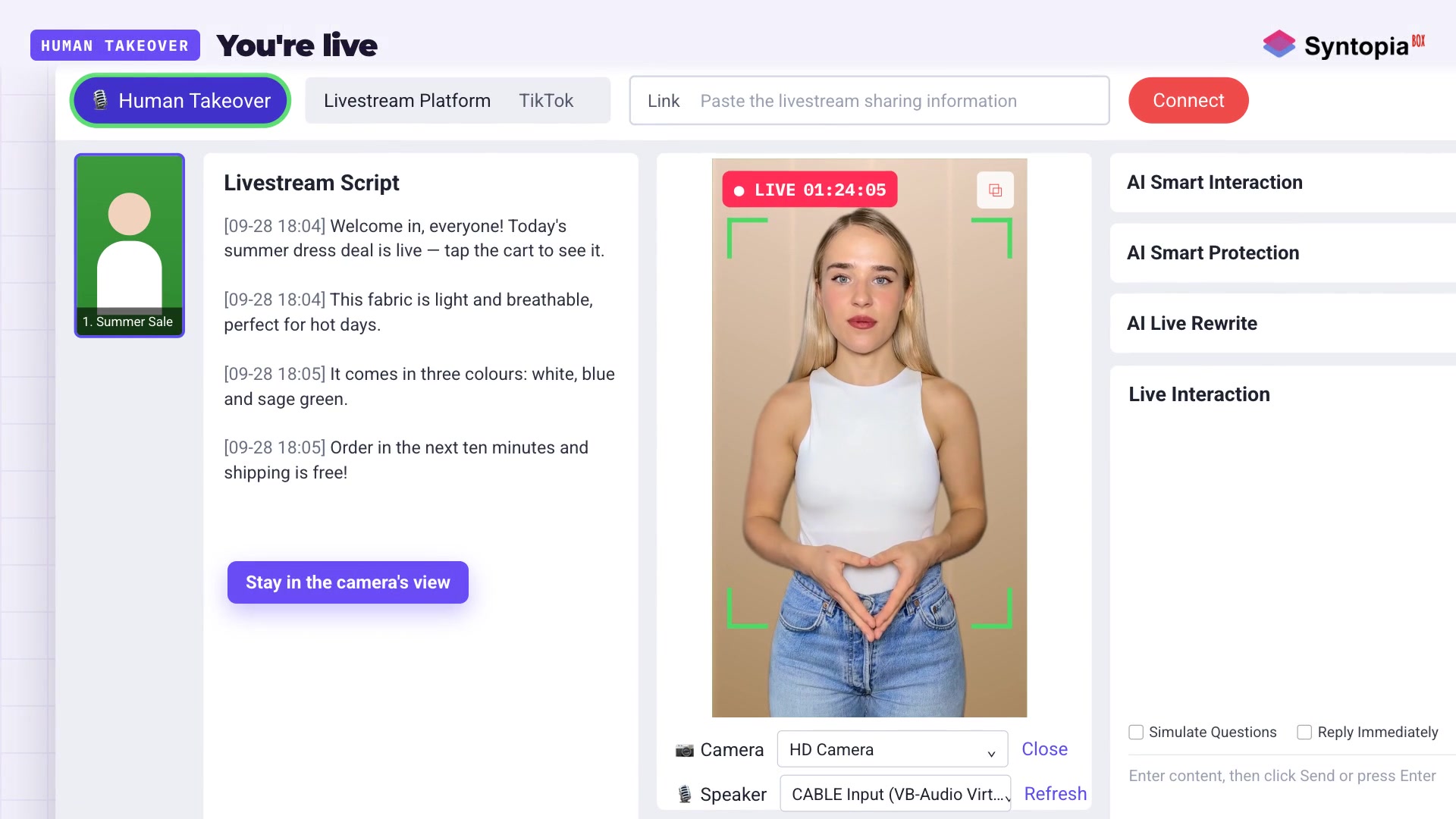
Human takeover is the bridge between the two modes. It lets a real person step into a running AI stream and drive it live — the avatar becomes the face for a human who is now speaking and reacting in real time — then hand back to the script. This is what makes “you don’t need a person on camera full-time, but you can have one the instant it matters” true in practice. The full mechanics are in our guide to human takeover in AI live selling.
Staffing: one operator, many rooms
Because fully-scripted streams run unattended once configured, the staffing model inverts: instead of one host per room, you have one operator supervising many rooms. That operator sets up avatars and scripts, watches the dashboards, and takes over any room that needs a human touch. With no hard cap on rooms — capacity scales with PCs and shop accounts — a small team can cover what used to need a roomful of hosts. How that works across shifts is covered in AI host teams and shift changes.
A practical picture: one operator starts the morning by launching several scripted rooms across different products and accounts, then spends the day watching dashboards rather than performing. When a room draws an unusually engaged audience or a big-ticket question, they drop into that room with human takeover, handle it live, and hand back to the script. The headcount that used to scale one-to-one with rooms now scales with how many rooms genuinely need a human at the same moment — which is almost always far fewer than the number of rooms running.
Compliance and disclosure basics
If viewers are watching an AI avatar rather than a live human, many markets and platforms expect that to be clear. Building disclosure into your stream and using an avatar model and voice model you have the right to use (ideally your own or a consenting presenter’s) keeps you on solid ground. The broader question of what is required where is covered in is it legal to sell live with an AI host — and note that is general guidance, not legal advice.
Setup overview
So: no, you do not need a real person on camera for every hour — but the strongest setups always keep a human in the loop, ready to drive. See the full feature set on the AI live selling software hub.
Frequently asked questions
Do you need a real person for AI live selling?
Not on camera, and not for every hour — but a real human is always involved somewhere. In a fully-scripted stream the AI host runs on its own from your script and answers comments automatically, with a person only setting it up and monitoring. In real-person-driven and human-takeover modes an actual human drives the stream live and the AI handles the lip-sync and voice. So you never need a person performing on camera full-time, but you do need a human to set up, supervise and, when you choose, drive.
What does 'real-person driving' mean in Syntopia BOX?
It means a genuine human being controls the stream in real time — speaking, choosing what to say and reacting to the room — while the AI only synchronises the avatar’s mouth and voice to that human. The AI is not improvising the sale; the person is. This is different from a fully-scripted AI stream, where the AI reads your prepared script and answers chat on its own.
Can one person run several AI live rooms at once?
Yes. Because fully-scripted streams run unattended once configured, a single operator can set up and monitor many rooms in parallel across PCs and shop accounts, with no hard cap on how many you run. The operator supervises and steps in where needed rather than performing in each room, which is what makes multi-room selling practical without a large team.
Do platforms require a human to be present during AI live selling?
Policies differ by platform and change over time, and some expect a human to be reachable or in the loop even when an AI host is presenting. Always check the current rules for your platform before relying on fully unattended streams, and keep human takeover available so a person can step in live if a situation calls for it. This is operational guidance, not legal advice.
Is a fully-scripted AI stream or a human-driven one better?
Neither is universally better — they solve different problems. Fully-scripted streams are ideal for covering long hours, nights and many rooms cheaply. Human-driven streams suit high-touch moments, launches and anything needing live improvisation. Many sellers use scripted streams for the long tail of hours and switch a human in for peak events via takeover.