
If you are comparing Syntopia BOX and DeepBrain AI, you are likely choosing between two kinds of AI human: one that renders a polished avatar video, and one that stands in a live shopping room. DeepBrain AI (AI Studios) is strong at the first; Syntopia BOX is built for the second. Here is how they line up as a DeepBrain AI alternative for AI live selling.
DeepBrain AI at a glance
DeepBrain AI, through its AI Studios product, generates realistic avatar videos from a script and also powers real-time conversational “AI human” deployments such as kiosks and customer service. It is a serious, well-engineered platform with convincing avatars and broad language support. Its centre of gravity for commerce, though, is still generated video and conversational endpoints — not a turnkey tool for running many live shopping streams.
Avatar realism and languages
On raw avatar realism, DeepBrain AI is excellent — it is one of the platform’s selling points, and it supports a wide range of languages for TTS output. Syntopia BOX trains a natural AI avatar too, from a short clip of a presenter, and the quality of that avatar depends heavily on clean, well-lit footage. For a live host the bar is slightly different from a rendered video: the avatar must move naturally for hours, turn, hold a product and react — realism in motion, not just in a 60-second clip.
That difference changes what “good” even means. In a rendered clip, you judge a single take: lip-sync, lighting and a few seconds of gesture, all of which you can re-render until they are flawless. In a live room there are no re-takes — the host has to stay convincing across an entire session, through pauses, product demos and unscripted answers, without the uncanny stiffness that creeps in when an avatar is asked to do more than talk. This is why BOX puts so much weight on the training footage: a presenter who moves naturally on camera gives you a host that can later sit, stand, hold items and gesture believably for the length of a real stream. Peak realism in one frame and sustained realism over two hours are genuinely different targets.
Real-time live vs generated clips
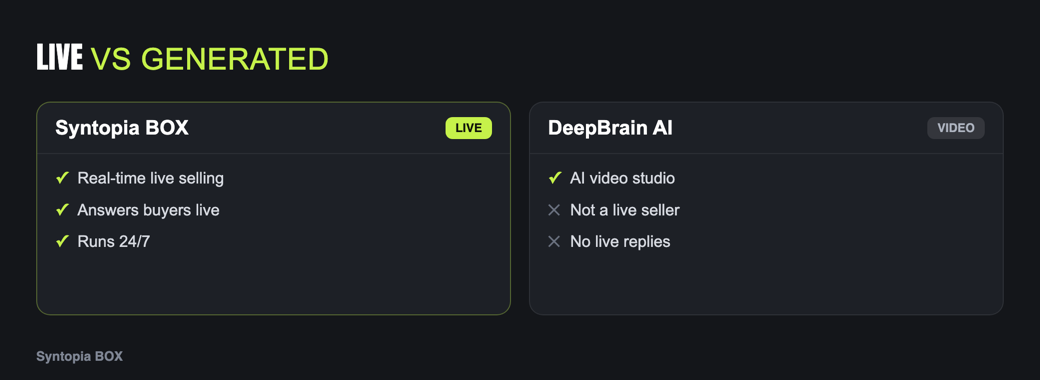
This is the core split. DeepBrain AI’s commerce output is generated video you publish, plus conversational deployments for support-style use. Syntopia BOX streams a host live to TikTok, YouTube or Shopee, reading the comment feed and answering out loud in the moment. If your plan is a library of product videos, DeepBrain AI fits; if your plan is an always-on live store, BOX is the category that matches.
A generated clip is finished the moment it renders. A live room is never finished — it reacts to whoever just walked in.
Concurrent rooms and scale
Live selling at scale means many rooms running at once. Syntopia BOX treats that as a native capability: hundreds of concurrent live rooms, no hard cap, by adding PCs and BOX accounts — see running multiple lives at once. DeepBrain AI’s video generation scales as a rendering service, but that is not the same as orchestrating dozens of simultaneous live selling streams.
On-prem data control
Syntopia BOX runs on-premise on your own Windows PC. Your training footage, scripts and runtime stay on hardware you control, which matters for brands with data-handling requirements. DeepBrain AI is primarily a cloud platform, with on-prem typically reserved for enterprise arrangements.
Voice: V10 training vs stock voices
DeepBrain AI offers many stock and custom voices across languages for its generated videos. Syntopia BOX takes a live-first approach: for each market you record a short voice sample and train a V10 voice model, so the live host speaks that language in its own trained voice rather than reading a single pre-rendered track. Details are in the voice model guide.
Feature comparison
| Tool | Real-time live? | Concurrent rooms | On-prem | Answers live chat | Per-language voice training |
|---|---|---|---|---|---|
| Syntopia BOX | Yes | Hundreds (no hard cap) | Yes (Windows) | Yes | Yes — record + train V10 |
| DeepBrain AI | Partial (video + kiosk/CVI) | Not live-selling focused | Enterprise only | Conversational endpoints | Many stock/custom voices |
DeepBrain AI capabilities are summarised from public positioning and may change; verify current details with the vendor.
Generated video still has a place
None of this is an argument that generated avatar video is obsolete — DeepBrain AI is popular for good reasons. Pre-rendered clips are predictable and brand-safe: you can review and re-render until every word and frame is right, which is exactly what you want for regulated claims, formal announcements and polished ads. They localize cleanly into many languages and sit happily in email, landing pages and marketplaces. For a lot of marketing, that controlled, repeatable output is the whole point.
The question is simply which problem is in front of you. If you need a catalogue of approved videos, a studio-video platform is the right tool. If you need a presence that is live — reacting to real viewers, running overnight, spanning many rooms — no amount of render quality substitutes for a host that is actually on air. Many brands end up using both: generated video for the assets that must be perfect, and a live host for the always-on store.
A typical scenario: from clips to a live store
Say a brand has been producing DeepBrain AI product videos and posting them on a schedule. Views are fine, but conversion lags because nobody is there to answer “does this fit a UK three-pin plug?” or “is the blue still in stock?” in the moment. Those unanswered questions are abandoned carts.
With Syntopia BOX, the same brand stands up a live room where the host answers exactly those questions out loud as they scroll in, references the pinned product card, and keeps the room warm overnight for other time zones. The generated videos still run as ads and top-of-funnel content; the live room becomes the place where interested viewers actually convert. Different jobs, and the live job is the one a video generator cannot do.
Which should you pick?
For realistic generated avatar video, or a conversational AI human for support and kiosks, DeepBrain AI is a strong, polished choice. For an AI host that sells live — many rooms, on your own hardware, answering comments in real time, with a voice trained per language — Syntopia BOX is purpose-built. See current plans on the pricing page, or weigh the wider field in the best alternatives guide.
Frequently asked questions
Is DeepBrain AI good for AI live selling?
DeepBrain AI is excellent at realistic generated avatar video and runs conversational AI humans for kiosks and support. For running many live shopping streams it is less of a fit than a purpose-built live tool such as Syntopia BOX, which streams a host live and answers comments in real time.
What is the main difference between Syntopia BOX and DeepBrain AI?
DeepBrain AI centres on generated avatar video and conversational endpoints; Syntopia BOX is an on-premise app that runs AI hosts live in shopping rooms, scaling to hundreds of concurrent rooms and answering live comments out loud.
Does Syntopia BOX match DeepBrain AI on avatar realism?
BOX trains a natural AI avatar from a short presenter clip, and quality depends on clean, well-lit footage. For live selling the key is realistic movement over hours, including holding products and reacting, rather than only a short rendered clip.
How does voice work in Syntopia BOX versus DeepBrain AI?
DeepBrain AI provides stock and custom voices for generated videos. In BOX you record a short sample per language and train a V10 voice model, so a live host speaks each language in its own trained voice.
Can I run Syntopia BOX on my own hardware?
Yes. Syntopia BOX is on-premise and runs on your own Windows PC, keeping footage and scripts on hardware you control, and you scale rooms by adding more PCs.