

The fastest way to reduce live selling returns is not a stricter returns policy — it is a better demonstration. Most returns come from a gap between what the buyer expected and what arrived: wrong size, a colour that looked different on screen, a feature they misunderstood. A good live demo closes that gap before the order is placed. This guide shows how to show true size and colour on camera, answer sizing and spec questions live, and write scripts that pre-empt returns, all with Syntopia BOX.
Why high-return categories need better demos
Some categories return at punishing rates — apparel for fit, anything where colour matters, gadgets where a spec is misread. Returns quietly eat the margin a sale appeared to make: you pay shipping both ways, handling, and often lose the item to damage. The root cause is almost always an expectation gap, and live selling is uniquely good at closing it because the buyer can see the product in motion and ask before they commit.
The flip side: a sloppy live demo can increase returns by overselling. The goal is not hype — it is an accurate, convincing demonstration.
It helps to treat returns as a cost you can design out rather than an unavoidable tax on selling. Every return has a story — the jumper that was bigger than it looked, the gadget that did not do the one thing the buyer assumed. Those stories repeat, and once you know the three or four that drive most of your returns in a category, you can answer each of them on camera before the order is placed. Live selling is the one channel where you can do that in the moment, while the buyer is still deciding.
- Size and fit the buyer could not judge from photos.
- Colour or finish that looked different on a static image.
- A feature or spec the buyer misunderstood.
- Expectations set too high by marketing copy.
Showing true size, scale and colour
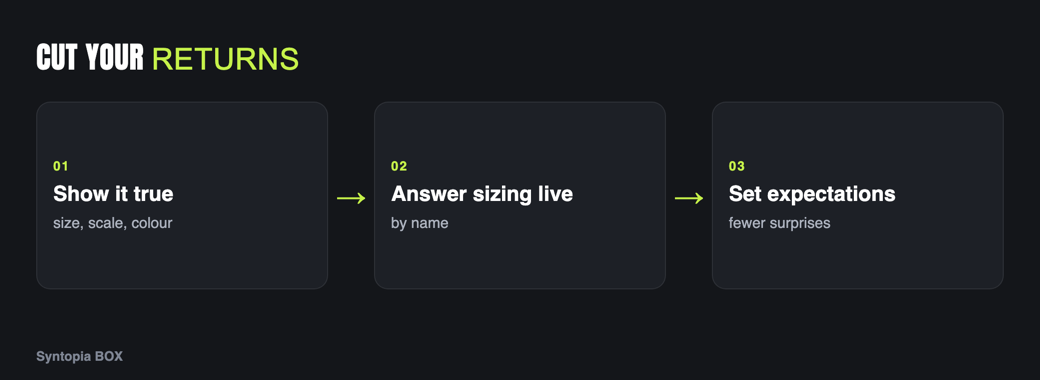
A trained Syntopia BOX avatar does not just talk about a product — it can hold it, wear it and show it to the camera. That is exactly what cuts returns. The avatar can hold an item next to a familiar object for scale, wear a garment so viewers see real drape and fit, turn it under the light so the true colour and finish read on camera, and demonstrate how a part moves or fastens. Buyers who have seen the product behave on camera are far less likely to be surprised by the parcel.
Answering sizing and spec questions live
Most return-driving doubts show up as questions in the chat: “will this fit a wrist like mine?”, “is the grey warmer or cooler?”, “does it work with X?”. Left unanswered, the buyer guesses — and a wrong guess becomes a return. Syntopia BOX answers these in real time with smart live chat, replying out loud in the host’s voice about sizing, materials, compatibility and care. Connect your own AI model so the answers reflect your real specs, not guesses. Every accurate answer before purchase is a return avoided after it.
Accurate expectations mean fewer returns
The single most powerful lever is honesty on camera. Call out the true fit (“this runs small, size up”), the real weight, the actual colour in normal light, what the product does not do. It feels counter-intuitive to temper the pitch, but a buyer who gets exactly what they expected keeps the item and comes back. An AI host does this consistently on every run, where a human might skip the caveats when they are tired or rushing.
A return is usually a promise the demo did not keep. Keep the promise on camera and the item stays sold.
Real-scene demos vs studio
Showing a product in a realistic setting beats a sterile studio shot for setting expectations. A kitchen gadget demonstrated on a worktop, furniture shown at human scale, clothing worn and moved in — these tell the buyer what the product is actually like to own. A BOX avatar can present in a scene that matches the product, so viewers judge it in context rather than against an idealised backdrop. The closer the demo is to real use, the smaller the expectation gap.
Context also pre-empts a whole class of returns driven by use-case mismatch — the buyer who assumed a product fit a space, a routine or a device it was never meant for. Seeing it in a true setting quietly answers “will this work for me?” before it becomes a disappointed unboxing. It is the difference between a buyer imagining the product and a buyer watching it behave.
Scripts that pre-empt returns
Bake return-prevention into the script itself. For every product, add a short “is this right for you?” beat: who it suits, who it does not, the sizing note, the care instruction, the one thing people most often get wrong. Because the AI host delivers the script consistently, those caveats get said on every stream, at 3am as reliably as at peak. You write the honest version once and it is never skipped.
Measuring the impact on returns
Treat return rate as a live-selling metric, not just a logistics one. Track returns by product and by the script version that sold it, and watch the rate as you tighten demos and add pre-empting beats. Pair that with the engagement metrics BOX surfaces — which questions came up most often points straight to the expectation gaps worth closing next. We quote no figures here; measure against your own baseline. The win to look for is a falling return rate at a steady or rising conversion rate — proof the demo is setting expectations better without costing you sales. Current plans are on the pricing page.
Frequently asked questions
Can AI live selling actually reduce returns?
Yes, by closing the expectation gap that causes most returns. A trained Syntopia BOX avatar can hold, wear and show a product so buyers see its true size, fit, colour and behaviour before they order, and smart live chat answers sizing and spec questions in real time. Buyers who got exactly what they expected are far less likely to send it back.
How does an AI host show true size and colour?
Once trained, the avatar moves like a real person: it can hold an item next to a familiar object for scale, wear a garment to show real drape and fit, turn it under the light so the true colour and finish read on camera, and demonstrate how parts move. Showing the product in a realistic scene rather than a sterile studio further narrows the gap between screen and parcel.
How does live chat help cut returns?
Most return-driving doubts show up as chat questions about fit, colour or compatibility. If they go unanswered, buyers guess, and wrong guesses become returns. Smart live chat answers them out loud in real time in the host’s voice, and you can connect your own AI model so answers reflect your real specs. Each accurate pre-purchase answer is a return avoided.
Should the script mention a product’s downsides?
Yes. Accurate expectations are the strongest lever on returns, so build an honest ‘is this right for you?’ beat into every script: who it suits, who it does not, sizing notes and common mistakes. Because the AI host delivers the script consistently, those caveats are said on every stream rather than skipped when a human host is tired or rushing.
How do I measure whether returns are falling?
Treat return rate as a live-selling metric. Track returns by product and by the script version that sold it, and watch the rate as you improve demos and add return-pre-empting beats. The engagement data Syntopia BOX surfaces, such as which questions came up most, points to the expectation gaps worth closing next. Measure against your own baseline rather than any published figure.