
Both Syntopia BOX and Tavus can put a real-time AI human on screen — but they are built for different people. Tavus is a conversational video API that developers embed into their own products. Syntopia BOX is a turnkey AI live-selling application that a seller installs and goes live with. If you are weighing a Tavus alternative for AI live selling, this comparison explains which side of that line you are on.
What Tavus is
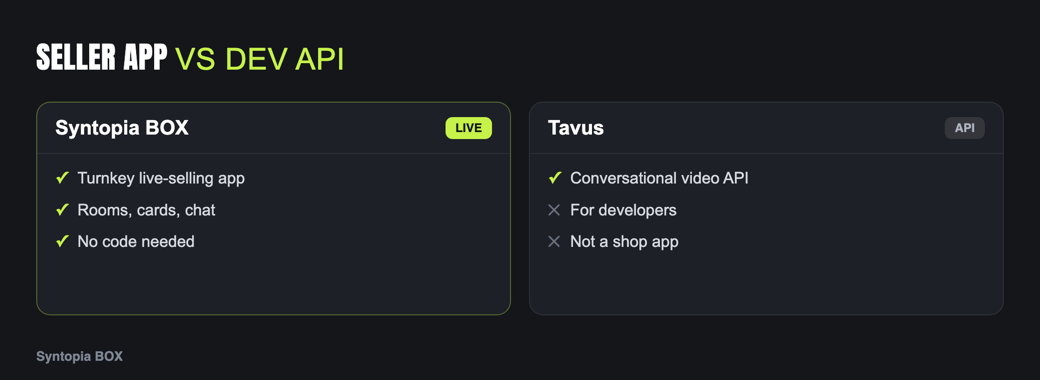
Tavus is a developer platform for conversational video — a real-time digital-human interface delivered through an API and SDK. It is genuinely real-time and technically strong: you can build a talking, listening digital human into an app, a website or a support flow. The key word is build. Tavus gives engineering teams the pipes; your team assembles the experience, the UI, the commerce logic and the platform connections around it.
What Syntopia BOX is
Syntopia BOX is a finished application for one job: running AI hosts in live shopping rooms. There is no SDK to integrate. You install the Windows app, train an avatar model from a short clip, give it a voice, connect your shop, and stream live to TikTok, YouTube or Shopee. The host reads the live comment feed and answers out loud, shows the product, and runs unattended. It is sold to sellers and agencies, not to developers.
API vs application: who each is for
This is the whole decision in one line: do you want to build a product, or run a live store?
Concurrent selling rooms
With Tavus, concurrency is whatever you engineer and provision through the API — it scales, but you own the architecture and the orchestration. With Syntopia BOX, concurrency is a built-in feature of the product: run hundreds of concurrent live rooms, effectively unlimited with no hard cap, by adding more PCs and BOX accounts. For a seller, that difference is the gap between a project plan and a setting. See how to run multiple lives at once for how that works in practice.
It is worth being precise about what “concurrency” costs in each model. On an API you pay for sessions and compute as you scale, and you also pay in engineering time to keep dozens of sessions healthy, to retry the ones that drop, and to balance load as traffic swings through the day. In BOX, a room maps to hardware you can see: one PC carries a number of rooms, and when you want more rooms you add machines. Neither model is without cost, but one hides its scaling complexity in code you maintain, and the other turns it into a capacity plan you can reason about with a spreadsheet.
Live comments and product cards
Selling live is mostly about answering the room. BOX ships the commerce layer: it reads the live comment stream and the host answers out loud, and you pin product cards that the host references on cue — see smart live chat. Tavus can hold a real-time conversation through its API, but turning that into shopping-comment handling, pinned products and checkout prompts is work your team does.
Deployment: cloud API vs on-prem
Tavus runs as a cloud API — your conversations flow through its service. Syntopia BOX runs on-premise on your own Windows PC, so your training footage, scripts and runtime stay on hardware you control, and you scale by adding machines. For sellers with data-control requirements or many rooms to run, on-prem is often the deciding factor.
Feature comparison
| Tool | Real-time live? | Concurrent rooms | On-prem | Answers live chat | Per-language voice training |
|---|---|---|---|---|---|
| Syntopia BOX | Yes (turnkey) | Hundreds (no hard cap) | Yes (Windows) | Yes, built-in | Yes — record + train V10 |
| Tavus | Yes (via API) | You engineer it | No (cloud API) | Conversational, you build the commerce layer | Supported in-platform |
Tavus capabilities are summarised from its public developer positioning and may change; verify current details with Tavus. For more head-to-heads see the comparison hub.
What building on Tavus actually involves
“Use the API” hides a lot of work, so it is worth being concrete about what a seller would have to build to turn Tavus into a live-selling system. At minimum you are looking at: a front end for the stream and the shopper experience; session and state management so each room keeps its own context; logic that pulls the live comment feed from each platform and feeds it to the conversation; the commerce layer — product catalogue, pinned cards, pricing, checkout prompts; moderation and guardrails so the host stays on-script and on-policy; orchestration to launch, monitor and recover many concurrent sessions; and ongoing maintenance as platforms and models change.
That is a product, not a weekend project, and it needs engineers on staff indefinitely. Syntopia BOX exists because most sellers and agencies do not want to own that stack — they want the outcome. BOX ships the comment handling, product cards, moderation and multi-room orchestration as features of the application, so the thing you would spend months building on an API is already there. The trade-off is control: Tavus gives you a blank canvas, BOX gives you a finished live-selling console.
A typical scenario: a cross-border seller
Picture a seller who wants an AI host selling the same catalogue live in three languages, around the clock, on TikTok and Shopee. On Tavus, that means engineering three concurrent conversational sessions, wiring each to the right platform’s comment stream, building the product-card and checkout layer, and provisioning enough capacity to keep them all live — then maintaining it.
In Syntopia BOX the same seller trains one avatar, records a short voice sample and trains a V10 voice model for each of the three languages, builds three live rooms, and routes them to the platforms — adding PCs if they want more rooms. No code, and scaling to more markets later is more of the same setup, not more engineering. That is the practical meaning of “turnkey” versus “API”.
Which should you pick?
If you employ engineers and want a conversational avatar woven into your own software, Tavus is a capable foundation. If you are a seller or agency and the goal is an AI host selling live — across many rooms, on your own hardware, answering comments without a build project — Syntopia BOX is the shorter path. Compare current plans on the pricing page and browse other options in the best alternatives guide.
Frequently asked questions
Is Tavus a good Syntopia BOX alternative for AI live selling?
Tavus and Syntopia BOX overlap on real-time avatars but serve different buyers. Tavus is a conversational video API for developers to build on; Syntopia BOX is a turnkey AI live-selling app a seller installs and streams with. For AI live selling without a build project, BOX is the closer fit.
Does Tavus run live shopping rooms out of the box?
Not as a finished seller product. Tavus provides a real-time conversational video API, and your team builds the shopping experience, comment handling and platform connections around it. Syntopia BOX ships those as features.
Can Syntopia BOX run many rooms at once like a Tavus build?
Yes. Concurrency is built into BOX: you run hundreds of concurrent live rooms with no hard cap by adding more PCs and BOX accounts, rather than engineering and provisioning it yourself.
Is Syntopia BOX cloud-based like Tavus?
No. Syntopia BOX is on-premise and runs on your own Windows PC, so your footage, scripts and runtime stay on hardware you control. Tavus is delivered as a cloud API.
Do I need developers to use Syntopia BOX?
No. BOX is an application for sellers and agencies, not an SDK. You install it, train an avatar and voice, connect your shop and go live without writing code.