
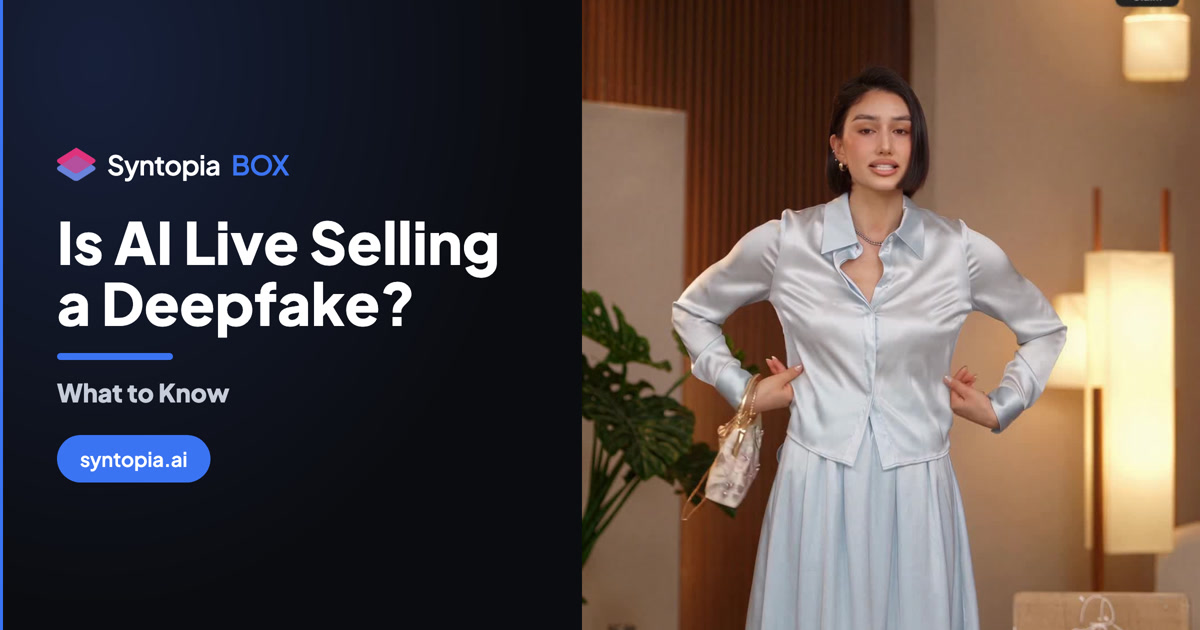
No — AI live selling done the Syntopia BOX way is not a deepfake. A deepfake uses someone’s likeness without consent. With BOX you build and own your avatar and a voice model you create by recording and training on audio you provide — not by imitating a real person you have no rights to. The honest practice is to disclose that the host is AI, use only likenesses you have the right to, and — where a real human drives the stream — be clear a real person is live. This is general information, not legal advice.
- A deepfake uses a real person’s likeness without consent; an owned AI host does not.
- You create and own the avatar, and build the voice by recording and training.
- Disclose that the host is AI — transparency is the line.
- Real-person driving means a real human is genuinely live.
“Deepfake” vs a licensed avatar and voice model you own
The word “deepfake” has a specific meaning: synthetic media that puts words or actions onto a real, identifiable person without their consent, typically to deceive. That is not what an owned, disclosed AI host is. The difference isn’t the technology — it’s consent, ownership and transparency.
Get those three right and you’re running a legitimate AI host; get them wrong and you’re in deepfake territory regardless of the tools. The rest of this guide is really about staying firmly on the right side of that line, which is straightforward when you build on assets you own and tell viewers the truth.
| Deepfake (problematic) | Owned AI host (Syntopia BOX) | |
|---|---|---|
| Likeness | A real person, used without consent | Your own avatar, or one you have rights to |
| Voice | Imitating someone without permission | A voice model you record and train on audio you provide |
| Intent | To deceive | To present and sell, openly disclosed |
| Disclosure | Hidden | Clearly stated it’s an AI host |
You use your own avatar and a voice you record and train
In Syntopia BOX, your host is an AI digital human you create — either a synthetic avatar or one built from footage of a presenter who has agreed to it. It is yours, not a captured image of a stranger.
For the voice, you aren’t taking someone else’s voice; you record a sample and train a voice model of your own, and for each language you record a fresh sample and train it so the host speaks that language in a voice you control. Ownership and consent sit with you at every step — which is precisely what a deepfake lacks.
That distinction matters practically, not just semantically. Because the avatar and each language voice are assets you built and hold, you can prove their provenance if a platform or partner ever asks — you recorded the footage, you recorded the audio, you trained the models. A deepfake, by definition, has no such clean chain of consent to point to.
Disclosure: being transparent it’s AI
The simplest ethical and compliance safeguard is to say so. Tell viewers the host is an AI host — in the stream, the profile, or wherever your platform expects it. Disclosure is increasingly required by platforms and is the clearest line between a legitimate AI host and something deceptive.
It also tends to help rather than hurt: audiences are comfortable with disclosed AI hosts, and transparency signals a brand that has nothing to hide. For the policy angle, see is it legal to use an AI host.
Consent and likeness rights done right
If your avatar is based on a real person — you, a colleague, a hired presenter — get clear, documented permission to use their likeness and voice for AI hosting, covering the markets and uses you intend. Consent that isn’t written down is a dispute waiting to happen.
And when a real human drives the stream, say so: real-person driving means a real person is genuinely live, not a synthetic stand-in. Never build an avatar or voice from someone you don’t have the right to use — that single rule keeps you clear of the deepfake line entirely.
How platforms treat disclosed AI hosts
Platforms are far more comfortable with AI hosts that are disclosed and built on consented likenesses than with hidden synthetic media. Running a clearly-labelled AI host on TikTok Shop, YouTube or Shopee, within their rules, is a different thing entirely from passing off a non-consented deepfake.
The practical takeaway: disclosed and consented is a well-trodden, accepted path; hidden and non-consented is the thing platforms and the law are built to catch. Choose the first and AI live selling is simply a modern presentation tool.
Ethical live selling checklist
- Use only an avatar and voice you own or have documented rights to.
- Build the voice by recording and training, per language — never by imitating someone without permission.
- Disclose clearly that the host is an AI host.
- When a real human drives the stream, say a real person is live.
- Keep claims honest and within platform policy.
Where the line is
The line is consent and honesty. An AI host you own, disclosed to viewers, built on likenesses you have the right to use, is legitimate marketing. Using a real person’s identity without permission, or hiding that a host is synthetic in order to deceive, is not.
Syntopia BOX is designed for the first and gives you no reason to approach the second. Start with the AI live selling pillar and current plans on the pricing page. This article is general information, not legal advice — confirm the rules for your market.
Stay on the right side of the line
The whole question comes down to three words: consent, ownership, disclosure. Honour all three and you’re running a legitimate AI host, not a deepfake.
Check the legal guide for the policy picture — this article is general information, not legal advice.
Frequently asked questions
Is AI live selling the same as a deepfake?
No. A deepfake uses a real person’s likeness without consent, usually to deceive. A Syntopia BOX host is an avatar and voice model you own and disclose, built on likenesses you have the right to use — the opposite of a non-consented deepfake.
Do I have to copy a real person’s face or voice to make an AI host?
No. You create an avatar you own and build the voice by recording a sample and training a voice model — and for each language you record a fresh sample and train it. You never imitate a person you have no rights to.
Do I have to tell viewers the host is AI?
Yes — disclose it. Transparency is increasingly required by platforms and is the clearest line between a legitimate AI host and something deceptive. When a real human drives the stream instead, say a real person is live.
What about likeness rights if the avatar is based on a real person?
Get clear, documented permission to use that person’s likeness and voice for AI hosting, covering your intended markets and uses. Never build an avatar or voice from someone you don’t have the right to use; consent is what keeps it legitimate.
Is using an AI host legal?
Disclosed AI hosts built on consented likenesses are widely accepted on platforms like TikTok Shop, YouTube and Shopee, within their rules. See the legal guide for the policy picture — and note this is general information, not legal advice, so confirm the rules for your market.
How do platforms treat AI hosts?
They are far more comfortable with disclosed AI hosts built on consented likenesses than with hidden synthetic media. A clearly-labelled AI host run within a platform’s rules is treated very differently from a non-consented deepfake.