

AI live selling in Southeast Asia is where live commerce is most mature and most competitive. Buyers across the region shop in live rooms daily, which means two things for sellers: the demand is real, and you cannot cover it with a single human host working one shift in one language. This guide covers the platforms that matter in the region, per-country notes, a local-language voice strategy, and how to stay compliant while running parallel localized rooms with Syntopia BOX.

Why Southeast Asia leads live commerce
Live shopping is not a novelty in Southeast Asia — it is a mainstream way to buy. High mobile use, a young audience and a culture of entertainment-led shopping have made live rooms a daily habit across the region. For sellers that is a large, ready market; it is also a crowded one, where being live more hours, in more languages, across more rooms is the edge. That combination — big demand, high coverage requirements — is what makes an AI host so well suited to the region.
The competitive reality is that in mature live-commerce markets, viewers have plenty of rooms to choose from at any hour. Winning attention is less about a single brilliant broadcast and more about being reliably present, answering fast, and showing up in the language and on the platform the buyer already favours. Those are exactly the things a human-only operation struggles to sustain across a multi-country, multi-language region — and exactly where an AI host earns its place.
The platforms that matter here
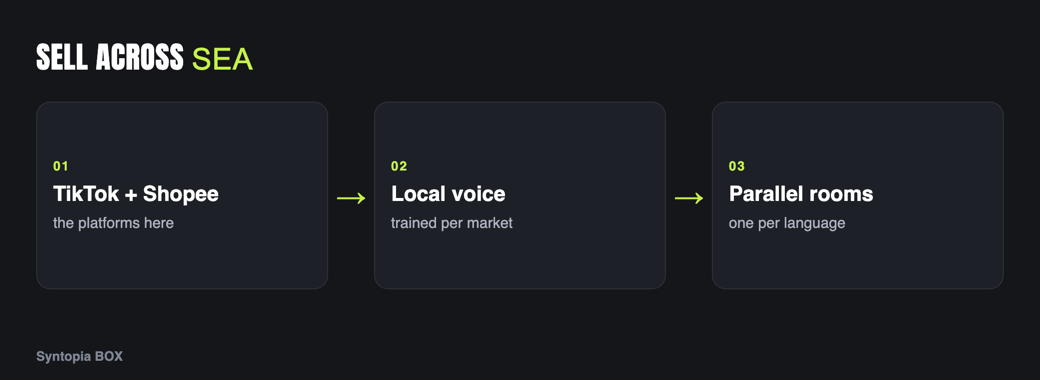
Across Southeast Asia, two platforms carry much of the live-commerce demand that Syntopia BOX supports: TikTok and Shopee. TikTok Shop has become a major live-selling surface across the region, and Shopee live is deeply established for product discovery and sale — the Shopee AI live-selling guide covers its setup in depth. Focus your effort on the platform your target country and category actually use; you do not need to be everywhere, you need to be live where your buyers are.
- Sell on the platform the market actually uses — TikTok and Shopee lead live commerce here.
- Host in the local language with a trained voice, not subtitles.
- Run several localized rooms in parallel to cover the region and the clock.
- Confirm platform rules and whitelisting for each market before you scale.
Country notes across the region
The region is not one market. Treat each country as its own audience, language and set of expectations:
- Indonesia — the largest audience and among the most active live-shopping markets; host in Bahasa Indonesia and expect strong value and bundle sensitivity.
- Thailand — entertainment-led live culture; a warm, lively host style in Thai tends to fit.
- Vietnam — fast-growing live commerce; host in Vietnamese and lean on clear value framing.
- Malaysia — often multilingual; choose the language your specific audience uses and keep offers locally framed.
- Philippines — highly social, chat-heavy rooms; responsive live chat matters even more here.
These are starting orientations, not rules — test and adjust per audience. The practical takeaway is that “Southeast Asia” should never be a single room with a single script. Each country deserves its own trained voice, its own localized script and its own sense of what a good offer looks like. Start with the one or two markets closest to your catalogue, get those rooms converting, then add the next country as a separate localized stream rather than stretching one room to cover them all.
Language and local-voice strategy
The non-negotiable for this region is hosting in the buyer’s language. For each market, record a short sample in the local language and train a voice model, then write the script in that language — the same per-language method in the cross-border guide. Do not translate one script word for word across the region; localize it to each market’s selling norms. A host that sounds native is the biggest single lever on trust and conversion in Southeast Asia.
Local offer and currency framing
Price and promote the way each market expects. Show the local currency, frame bundles and discounts to local shopping habits, and align timing with local peak hours and shopping seasons. Value sensitivity is high across much of the region, so a clear, well-framed local offer does more work than an aggressive one that reads as confusing when simply converted from another market.
Timing deserves its own attention. Each market has its own rhythm of paydays, weekends, festivals and regional shopping events, and a stream scheduled to land on those peaks will outperform the same stream run at an arbitrary hour. Because an AI host can run on a schedule across several countries at once, you can line each room up with its own market’s best windows rather than compromising on a single timetable that suits none of them well. Treat the calendar as part of the offer, not an afterthought.
Southeast Asia does not reward the loudest seller — it rewards the one who is live, local and always on.
Whitelisting per market
Each platform sets its own rules for AI hosting, and requirements can differ by country. Some accounts must be approved before AI hosting runs smoothly, so budget time to get whitelisted and keep any required AI disclosure in place per market. Treat compliance as per-country homework, not a one-time step — and note this guide is general information, not legal advice.
Running parallel localized rooms
The pay-off of doing the per-country work is that you can run it all at once. Syntopia BOX lets you run many rooms in parallel — one per country, language or platform — with no hard cap, scaling into the hundreds as you add PCs and accounts. One operator supervises the lot, and because the region spans several time zones, parallel rooms also help you stay live around the clock. For the broader method, see scaling live commerce globally, and current plans on the pricing page.
Frequently asked questions
Which platforms are best for AI live selling in Southeast Asia?
Across the region, TikTok and Shopee carry much of the live-commerce demand that Syntopia BOX supports. TikTok Shop is a major live-selling surface and Shopee live is deeply established for discovery and sale. Focus on the platform your target country and category actually use rather than trying to be on every platform at once.
Do I need to host in each country’s language?
For Southeast Asia, yes. Hosting in the buyer’s own language is the biggest single lever on trust and conversion. For each market you record a short sample in the local language, train a voice model on it, and write the script in that language, rather than translating one script word for word across the region.
Can one brand cover several Southeast Asian countries at once?
Yes. Once each market has its own trained voice and localized script, Syntopia BOX runs the rooms in parallel, one per country, language or platform. There is no hard cap, so capacity scales into the hundreds as you add PCs and accounts, and because the region spans several time zones, parallel rooms also help you stay live around the clock.
Is AI live selling allowed on these platforms in the region?
Each platform sets its own rules for AI hosting, and requirements can differ by country. Some accounts must be approved before AI hosting runs smoothly, so budget time for whitelisting and keep any required AI disclosure in place per market. Treat compliance as per-country homework. This guide is general information, not legal advice.
How should I frame prices and offers for the region?
Price and promote the way each market expects: show the local currency, frame bundles and discounts to local shopping habits, and time streams to local peak hours and seasons. Value sensitivity is high across much of Southeast Asia, so a clear, well-framed local offer outperforms an aggressive one that reads as confusing when simply converted from another market.
This regional strategy guide is general information, not legal advice. Confirm current platform rules and local requirements for each market yourself.