

Cross-border live selling across languages fails for one boring reason: buyers do not trust a host they cannot fully understand. A subtitled or stilted stream converts far worse than one hosted in the viewer’s own language. The fix is not to translate on the fly — it is to give each market a host that genuinely speaks its language. This guide shows how to train a voice model per language, localize avatars and scripts per market, and run parallel rooms with Syntopia BOX so one brand can sell natively in many places at once.
The language barrier that caps cross-border sales
Live selling is persuasion, and persuasion lives in language. A host who sounds native builds trust, handles objections and lands the offer; a host the viewer only half-follows loses all of that. This is why cross-border sellers so often stall: they have the products and the logistics sorted, but they are hosting every market in one language and quietly leaving most of their addressable demand on the table.
Human hosts make this worse, because a fluent native host for every target market is expensive and hard to retain. The result is usually one English stream serving everyone — and under-converting everywhere.
It is worth being precise about what the barrier actually is. It is not only vocabulary; it is accent, idiom, local references and the small-talk that builds rapport in a live room. A viewer can follow a subtitled stream and still not feel it was made for them, and in live selling that feeling is most of the sale. Closing the gap means sounding like a host from the viewer’s own market, not merely being understood by them.
Train a voice model per language
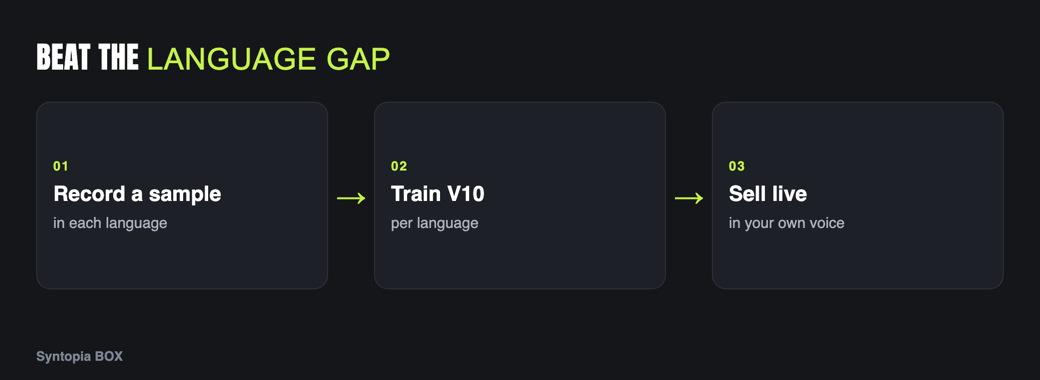
Syntopia BOX approaches languages the right way round. You do not “clone a voice once and magically speak everywhere.” Instead, for each language you want to sell in, you record a short sample in that language and train a voice model on it, then write your script in that language. The host then speaks that market’s language in a consistent, natural-sounding voice. BOX’s V10 voice family is built for foreign-language voices and the most common languages are pre-loaded, but the quality comes from recording and training per language, not from a one-click shortcut.
- Record a short, clean sample in the target language.
- Train a V10 voice model on it.
- Write the selling script in that language (localized, not literally translated).
- Run a room in that market with that voice and script.
Localized avatars and scripts
Language is only half of localization. The avatar, the examples, the offers and the tone should fit the market too. A pitch that lands in one country can fall flat in another, so adapt the script to local selling norms rather than translating it word for word. Where it helps, use a market-appropriate avatar. The principle is deep localization: you are re-making the stream for the market, not subtitling it. This is the same discipline behind scaling live commerce globally.
In practice that means writing the selling script natively for each market — the hook, the objections it answers, the comparisons it draws — so it reads as though it were created there. The product facts stay constant, but the way you frame value, urgency and trust shifts with the audience. Build each market’s script as its own asset you refine over time, not as a translation you maintain in lockstep with a master.
Which platforms fit which region
Different markets live on different platforms, and you should go where the buyers already are. Across Southeast Asia, TikTok and Shopee carry a great deal of live-commerce demand — the Shopee guide and the Southeast Asia guide go deeper. In Western markets, TikTok Shop is the primary live-shopping surface. Match each localized room to the platform that market actually uses rather than forcing every region onto one platform.
Local currency and offer framing
Buyers judge value in their own currency and their own conventions. Frame prices, bundles and promotions the way the local market expects, show the right currency, and align offers with local shopping habits and seasons. An offer that reads as generous at home can read as confusing or even off-putting abroad if it is just converted and pasted across.
Do not translate your stream. Re-make it for the market — its language, its voice, its offers, its platform.
Running parallel rooms per language
Once each market has its own voice and script, you run them at the same time. Syntopia BOX lets you run many rooms in parallel, one per language or market, with no hard cap — capacity scales with the PCs and accounts you add, into the hundreds if your hardware supports it. One operator can supervise the lot, and off-peak at home is often prime time in another market, so parallel rooms also smooth out your coverage across the clock.
This is where cross-border selling stops being a sequence of one-off market entries and becomes a single system. You add a market by adding a localized room, not by rebuilding your operation, and each new room benefits from everything you have already learned about scripting, scenes and offers. The marginal cost of the next country falls each time, which is the opposite of how a human-hosted expansion usually works.
Pitfalls to avoid
- Literal translation. Word-for-word translation reads as foreign and can create duplicate, low-quality copy. Localize the script instead.
- One voice everywhere. Reusing a single voice across languages undercuts trust. Train a voice model per language.
- Ignoring local compliance. Platform rules, disclosure expectations and consumer norms vary by region. Confirm the rules for each market and get accounts whitelisted where needed. This is general guidance, not legal advice.
- Converting prices without reframing offers. Match local currency and local offer conventions, not just the exchange rate.
Get these right and one brand can sell natively in many markets at once. Plans and capacity are on the pricing page.
Frequently asked questions
How does AI live selling handle different languages?
Not by translating on the fly. For each language you want to sell in, you record a short sample in that language and train a voice model on it, then write the selling script in that language. The AI host then speaks that market’s language in a consistent, natural-sounding voice. Syntopia BOX’s V10 voice family is built for foreign-language voices, but the quality comes from recording and training per language.
Can one brand run live rooms in several languages at once?
Yes. Once each market has its own trained voice model and localized script, Syntopia BOX runs the rooms in parallel, one per language or market. There is no hard cap, so capacity scales with the PCs and accounts you add, into the hundreds if your hardware supports it, and a single operator can supervise all of them.
Should I just translate my existing script for each market?
No. Literal, word-for-word translation reads as foreign, converts poorly, and can create duplicate low-quality copy. Localize instead: adapt the script to local selling norms, examples and tone, frame prices in local currency and align offers with local habits. You are re-making the stream for the market, not subtitling it.
Which platforms should I use in each region?
Go where the buyers already are. Across Southeast Asia, TikTok and Shopee carry much of the live-commerce demand; in Western markets, TikTok Shop is the primary live-shopping surface. Match each localized room to the platform that market actually uses rather than forcing every region onto a single platform.
Do I need to copy a real individual to sell in another language?
No. You train a voice model per language from a short recorded sample, and you use an avatar you have the right to use. The method is record-and-train per language, not reproducing a specific individual. Remember that platform rules, disclosure expectations and consumer norms differ by market, so confirm the rules for each region before you go live.