
AI live selling in Germany is moving into the mainstream as TikTok Shop opens the format to Europe’s largest consumer market. German buyers are deliberate and trust-driven, so the rooms that win are calm, informative and reliably live — exactly what an AI host sustains. This guide covers the supported platforms for Germany, EU disclosure, a German-language avatar and voice, local offer framing, and how to scale localized rooms with Syntopia BOX.
Why Germany is a live-commerce market to watch in 2027
Germany is the largest consumer market in Europe, and today live shopping is moving from a curiosity to a real sales channel here. TikTok Shop is now live for German sellers, which gives the format a mainstream surface it did not have a couple of years ago. German buyers are deliberate, value- and quality-conscious, and slower to trust a hard sell than shoppers in some live-commerce-native markets — so the room that wins is the one that is calm, informative and reliably present, not the loudest. That is exactly the kind of room an AI host sustains well: patient, consistent, and live for far more hours than a human can staff. See the AI live selling pillar for how the format works end to end.
The opportunity is less about novelty and more about coverage. A German catalogue often spans several categories and price points, and buyers research before they commit. An AI host that can run a long, steady, well-informed stream — answering the same practical questions patiently, in German, every evening — fits the market’s temperament better than a short, high-energy burst that leaves questions unanswered.
The supported platforms that matter in Germany
Keep your focus on where German live buyers actually are. TikTok Shop is the primary live-selling surface for Germany: it carries in-app discovery, the live room and checkout in one place, and it is where most first-time live buyers in the market will find you. YouTube matters too, as Germany’s dominant long-form video platform, for building a presenter’s reputation and driving viewers toward your live sessions — see whether AI live streaming is allowed on YouTube before you plan around it. Put your effort into one platform, get a room converting, then add the next; you do not need to be everywhere.
- Lead on TikTok Shop; use YouTube to build reputation and feed your live sessions.
- Host in German with a trained voice — not subtitles, not an accent that reads as foreign.
- Expect a high trust and transparency bar; disclose the AI host clearly.
- Frame offers in euros with German consumer-rights expectations built in.
AI-host rules and disclosure in Germany
Germany sits inside the EU’s transparency regime, so disclosure is not optional polish — it is the baseline. Under the EU AI Act’s transparency rules, content and interactions generated by AI should be identifiable as such, and German consumer-protection culture expects clear, honest labelling as a matter of course. Make it obvious in the room that the host is an AI avatar, keep product claims accurate, and honour the statutory right of withdrawal (Widerrufsrecht) and standard consumer rights in how you present offers. This is general information, not legal advice — see is it legal to use an AI host and confirm current requirements for your situation.
On the platform side, TikTok Shop’s own rules for AI hosting apply on top of EU law, and some accounts need approval before AI hosting runs smoothly. Treat disclosure and platform compliance as a standing part of the setup, not a one-off box to tick.
Localized avatar, voice and script strategy
German buyers notice when a host does not sound native, and it costs you trust fast. The method is the same one in the cross-border language guide: build an AI avatar that fits the market, then give it a German voice by recording a short sample in German and training a voice model on it, and write the script in German. Do not translate an English script word for word — localize it to how Germans actually buy: precise, specification-led, light on hype.
Script tone matters as much as language. Lead with concrete facts — materials, dimensions, compatibility, warranty — answer the practical objection before it is raised, and let the offer stand on clarity rather than pressure. A German-sounding host that explains well will out-convert a louder one that oversells.
Local offer, currency and timing
Price and present the way the market expects: show prices in euros, state shipping and returns plainly, and frame bundles so the value is obvious rather than engineered. German shoppers respond to transparent, fair offers and are quick to disengage from anything that feels like a countdown-timer gimmick.
Timing favours the evenings. Weekday evenings after work and the weekend are when a general-audience German room is most likely to find a live audience; schedule your main sessions there and treat quieter daytime hours as a chance to stay present rather than your peak. Because an AI host runs on a schedule, you can hold the evening slot every day without burning out a person — consistency at the right hour is its own advantage.
Whitelisting and going live
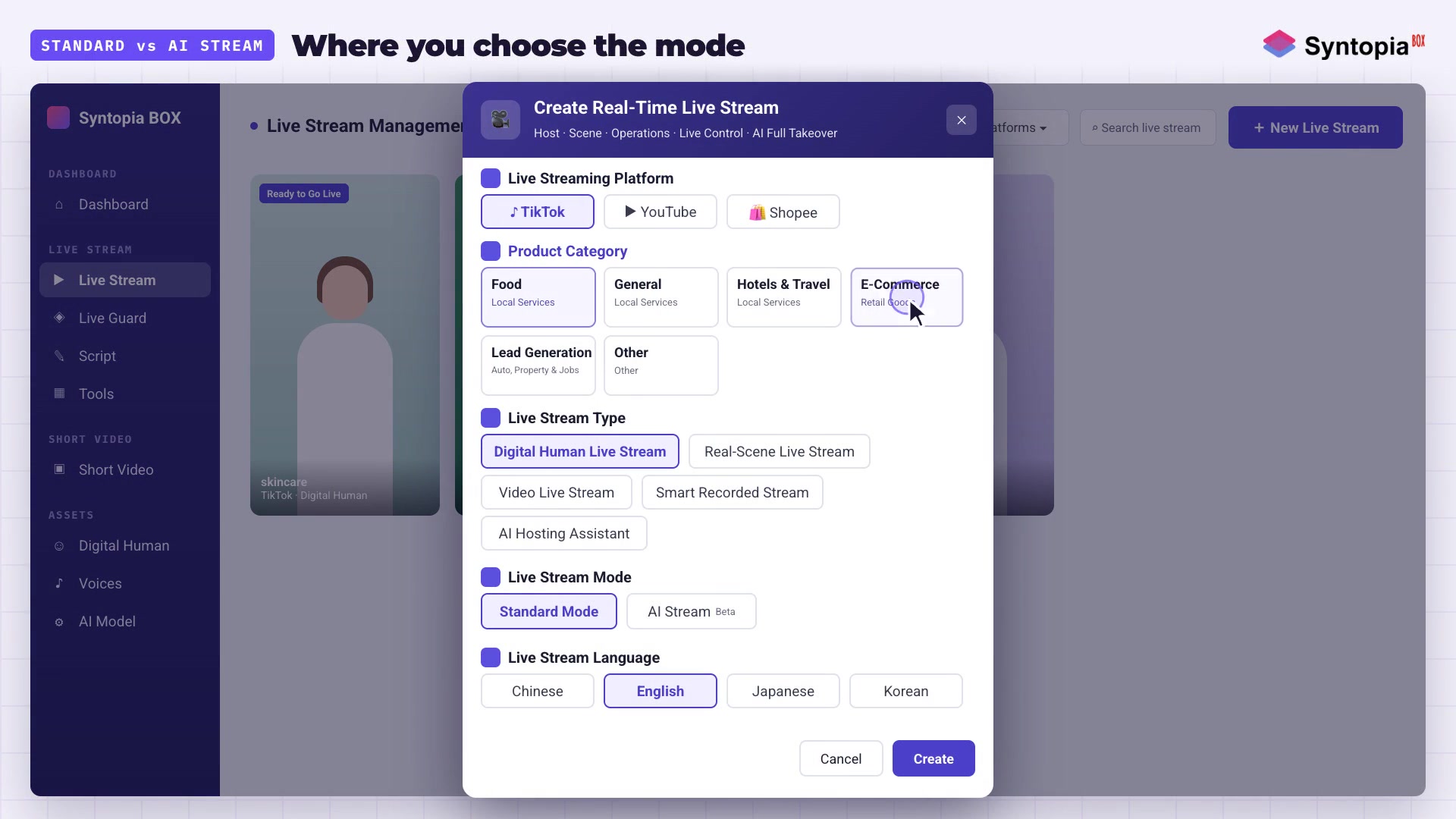
Before you scale, get the account side in order. Some sellers need to get whitelisted for AI live selling before AI hosting is reliable, so budget time for it and keep your AI disclosure in place throughout. Going live in Syntopia BOX then follows the standard flow: build your live room, route the host’s picture and voice into TikTok Shop, add your product cards, and let the AI run the session while you supervise.
Keep your first German room deliberately simple — one platform, one language, a tight product set — and get it converting before you add complexity. A clean, compliant, well-understood room is far easier to replicate than a sprawling one.
Running localized rooms at scale
Once your German room works, the same engine extends across Europe. Syntopia BOX can run many rooms in parallel — one per language, platform or market — with no hard cap, scaling into the hundreds as you add PCs and accounts. One operator can supervise the lot. The natural next steps from Germany are the neighbouring EU TikTok Shop markets: France and Italy, each as its own localized room rather than a translated copy of the German one.
For the broader playbook on taking one working room global, see scaling live commerce globally, compare tools on the AI live selling software hub, and check current plans on the pricing page.
Frequently asked questions
Which platform is best for AI live selling in Germany?
TikTok Shop is the primary live-selling surface for Germany, carrying discovery, the live room and checkout in one place. YouTube is valuable as the dominant long-form platform for building a presenter’s reputation and driving viewers to your live sessions. Focus on TikTok Shop first, get one room converting, then expand.
Do I have to disclose that the host is an AI in Germany?
Yes. Germany sits inside the EU’s transparency regime, where AI-generated content and interactions should be identifiable as such, and German consumer culture expects clear labelling. Make it obvious the host is an AI avatar, keep claims accurate, and honour standard consumer rights. This is general information, not legal advice.
Can my AI host sell in German?
Yes. You record a short sample in German, train a voice model on it, and write your script in German so the host speaks it naturally. Do not translate an English script word for word; localize it to German buying habits, which favour precise, specification-led selling over hype.
When should I schedule live streams for a German audience?
Weekday evenings after work and the weekend are when a general-audience German room is most likely to find a live audience. Because an AI host runs on a schedule, you can hold that evening slot reliably every day and stay present in quieter hours too, without burning out a human presenter.
How many German rooms can I run at once?
There is no hard cap. Syntopia BOX runs rooms in parallel, scaling into the hundreds as you add PCs and accounts, with one operator supervising. From Germany the natural next steps are neighbouring EU TikTok Shop markets such as France and Italy, each run as its own localized room rather than a translated copy.