

The best time to go live for sales is whenever your audience is online and ready to buy — there is no single universal hour. The reliable method is to read your own analytics, find your peak windows per platform, and schedule around them. The twist today: an AI host lets you also hold the off-peak and overnight hours human teams can’t, where competition is thin and intent is real. With Syntopia BOX you can cover both your peak and the hours everyone else skips.
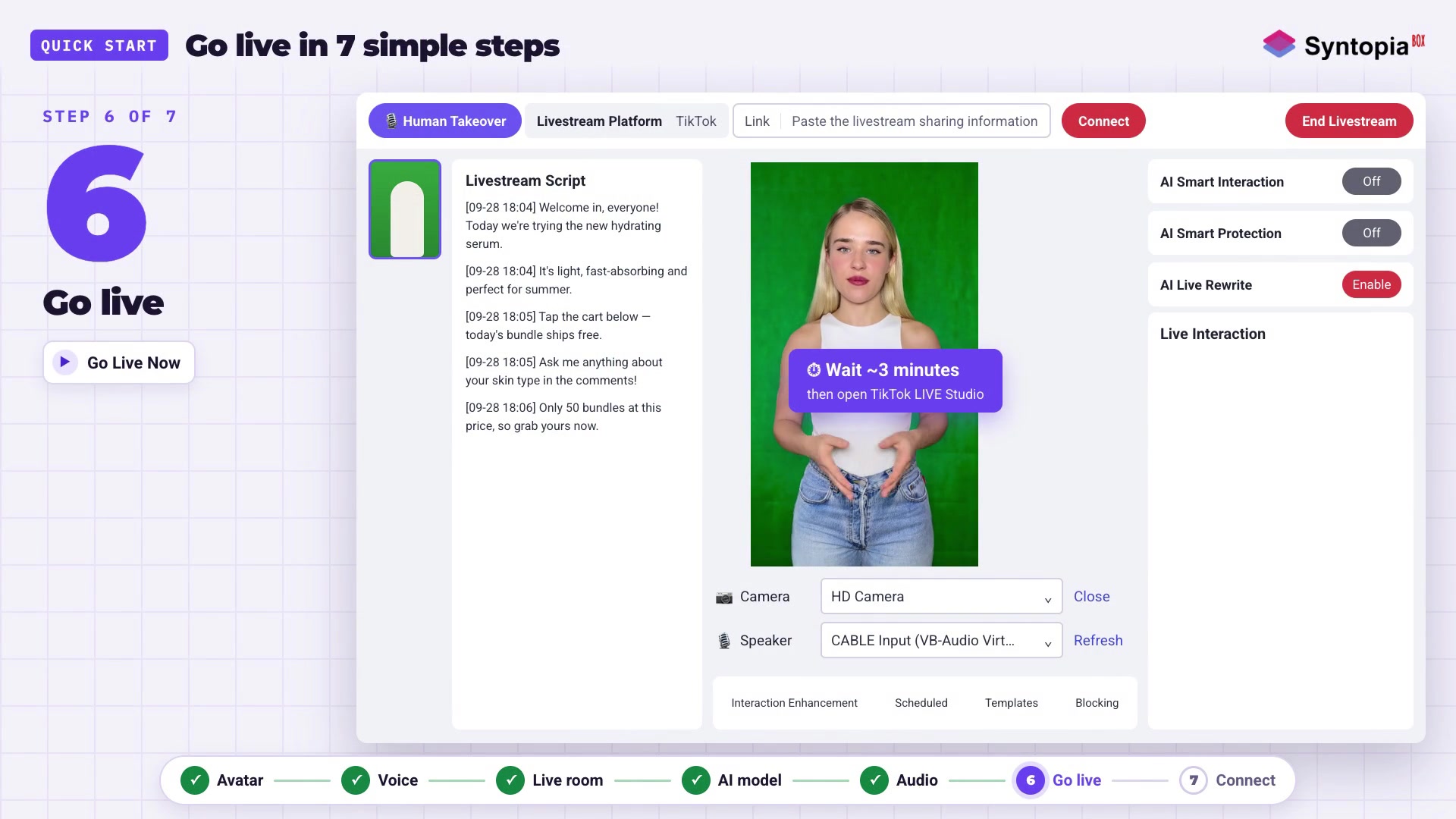
- There is no universal best hour — your analytics decide it.
- Weight toward the hours with the best conversion, not just the most views.
- Off-peak and overnight hours are uncontested, not empty — AI can hold them.
- Cross-border means several peaks; an AI host can be live through all of them.
Why timing moves conversion
Being live is only valuable if someone is there to watch. Go live when your audience is asleep or at work and even a great stream converts poorly; catch them when they’re browsing and relaxed and the same stream performs. Timing is a multiplier on everything else you do — your hook, your demo and your offer all depend on an audience being present to see them.
That’s why timing is the first thing to get right before you optimise anything else. A perfect stream at the wrong hour loses to an average stream at the right one. The rest of this guide is about finding your right hours and then extending your advantage into the hours competitors ignore.
How to find YOUR audience’s peak hours
Don’t guess — measure. Your stream analytics show when viewers actually arrive and, crucially, when they actually buy. Those two can differ: your busiest hour for views isn’t always your best hour for sales, and it’s sales you’re optimising for.
Look for the windows with the highest concurrent viewers and the best conversion, and treat those as your anchor slots. Re-check monthly, because audiences shift with seasons, campaigns and platform changes. Over a few weeks you’ll build a reliable picture of your own rhythm rather than borrowing someone else’s.
Platform-by-platform patterns
Patterns differ by where you sell, so treat these as starting hypotheses to confirm with your own numbers. On TikTok Shop, evenings and weekends tend to be busy as people scroll to unwind. YouTube live shopping often pairs with viewers’ regular watching habits — see the YouTube guide — so aligning with when your channel normally gets views helps.
Shopee activity clusters around paydays and the platform’s mega-sale dates, when buyers arrive primed to spend. If you sell across more than one of these, each platform may want a different schedule — another reason the ability to run many rooms matters.
Seasonality sits on top of all of this. The hour that works in a quiet week can be the wrong hour during a mega-sale, when the whole platform’s traffic shifts earlier or runs later into the night. Treat your peak-hour findings as a baseline for normal weeks, and plan to widen your coverage around big sale dates when buyer behaviour temporarily changes shape.
The off-peak advantage AI unlocks
Here’s the edge most sellers miss: the hours human teams can’t staff are not empty — they’re just uncontested. An AI host can run overnight and 24/7, so you capture the late-night browser and the early-morning shopper while competitors are offline and attention is cheap.
Off-peak isn’t second-best; it’s open space. A viewer who finds the only live room running at 3am has your full attention and no alternative to scroll to. Layering off-peak coverage on top of your proven peaks is often where the easiest incremental sales come from.
There’s a compounding benefit too: consistent off-peak presence teaches the platform that your room is always active, which can help it surface you more often at every hour. Coverage you add overnight doesn’t just capture the night owls — it can lift how discoverable you are during your peak windows as well.
Time zones for cross-border
If you sell across borders, “peak” is several peaks. A single human team can only be awake for one; an AI host can be live through all of them. Running continuously means you hit each region’s prime hours without asking anyone to work the night shift.
With localised rooms you can also match the language and offer to each region’s peak, so a buyer in another market lands on a stream that feels made for them at the hour they’re most likely to buy. For a global catalogue, that around-the-clock, multi-region coverage is a structural advantage.
Building a weekly live calendar
Turn your findings into a repeating plan: anchor your proven peak slots first, then layer in off-peak coverage to fill the clock. Lock it with scheduled streams so the room runs dependably and your audience learns when to show up.
A written calendar also makes testing disciplined — you can see at a glance which slots are proven, which are experiments, and where there are gaps. Pair this with the guide on getting more viewers to keep each slot filling up.
Testing slots
Timing is a hypothesis until you test it. Run the same format in different slots and compare conversion, not just views — the most-watched hour isn’t always the best-selling one. Change one thing at a time so you know what moved the result.
Keep what wins, drop what doesn’t, and revisit as your audience grows, because a slot that worked at launch can fade as your following shifts. See current plans on the pricing page and the companion guide on how long a stream should be.
Build your timing plan
Turn timing from guesswork into a repeatable system: measure your peaks, cover the uncontested hours, and keep testing as your audience shifts.
Combine the right hours with the right length — see how long a stream should be.
Frequently asked questions
What is the best time to go live to make sales?
Whenever your own audience is online and ready to buy — there’s no universal hour. Read your analytics to find your peak viewer and conversion windows per platform, anchor your streams there, then test adjacent slots.
How do I find my audience’s peak hours?
Use your stream analytics to see when viewers arrive and when they buy. Those two can differ, so weight toward the hours with the best conversion, not just the most views, and re-check monthly as your audience shifts.
Is it worth going live overnight or off-peak?
Often yes. Off-peak hours are uncontested rather than empty — an AI host can run overnight and 24/7 to capture late-night and early-morning shoppers while competitors are offline, which a human team can’t sustainably do.
When are TikTok Shop, YouTube and Shopee busiest?
As a starting point, TikTok Shop is busy in evenings and weekends, YouTube tracks viewers’ regular watching habits, and Shopee clusters around paydays and mega-sale dates. Treat these as hypotheses and confirm with your own analytics.
How do I handle time zones when selling cross-border?
Run continuously. Each region has its own peak, and an AI host can be live through all of them with localised rooms, so you hit every market’s prime hours without anyone working a night shift.
Should I schedule the same times every day?
Anchor your proven peak slots consistently so your audience learns when to return, then layer in off-peak coverage and test new slots around them. Consistency on your best hours plus coverage of the rest is the winning combination.