
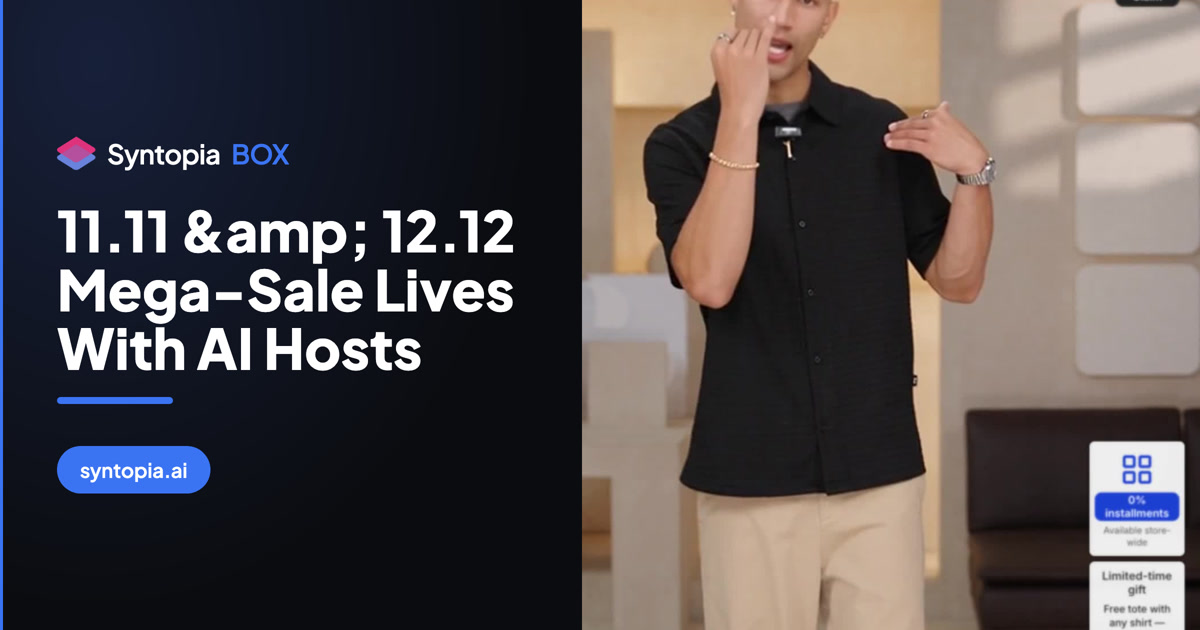
11.11 live selling — and its 12.12 sibling — is the year’s most concentrated live-commerce window. For a few days around each date, buying intent across Asia and beyond spikes to levels no other sale matches, and the shops that are live through the marathon take the orders. The catch is endurance: covering a multi-day mega-sale across markets and languages burns out any human team. An AI host runs the whole marathon. This guide covers how to prepare and run 11.11 and 12.12 with Syntopia BOX.
- 11.11 and 12.12 compress a year’s peak live-commerce intent into two multi-day windows.
- An AI host runs the full marathon — days of coverage — without the shifts and fatigue that break a human team.
- Syntopia BOX has no hard cap on rooms, so you can cover many markets, languages and platforms at once.
- Localized rooms with a voice trained per language reach each market in its own prime hours.
- Keep voucher and offer claims plain and guarded so high-volume rooms stay within policy.
Why 11.11 and 12.12 are the biggest windows
The 11.11 and 12.12 mega-sales are the calendar’s high-water marks for live commerce, strongest across Southeast Asia and the wider Asian market but increasingly felt everywhere. Around each date, shoppers wait specifically to buy — carts are loaded in advance, budgets are set aside, and the live rooms running during the window capture demand that has been building for weeks. These are not ordinary sale days; they are events the whole market plans around.
That concentration is the opportunity and the problem. The upside of being live through the window is enormous, but so is the cost of the gaps, because every hour is peak and every competitor is pushing. The decisive factor, as with any peak event, is coverage: who is live when the ready buyer looks.
Marathon coverage without a burnt-out team
A mega-sale is a marathon, not a sprint — often several days of near-continuous selling. No human host can carry that. Covering it with people means rotating shifts around the clock, overtime at premium rates, and the quality dips that come when tired hosts take the small hours. The shift-change problem that nags at any live operation becomes acute when the sale runs for days.
An AI host removes the endurance limit. A trained avatar on Syntopia BOX presents, demonstrates and answers the chat continuously across the whole window without tiring, so the room that is live at the opening hour is just as sharp at hour forty. You staff the marathon with machines and keep your people for oversight and the moments that genuinely need a human.
Multi-day, multi-room scheduling
A mega-sale is best run as a planned schedule, not an improvised stream. Map the whole window in advance — which products in which slots, which rooms live when — and use the scheduling tools to set it running so rooms open on time without anyone switching them on. Because Syntopia BOX has no hard cap on rooms, you can run many in parallel across the supported platforms such as TikTok Shop, YouTube and Shopee; the multi-room guide covers the mechanics and the limit is your hardware, not your headcount.
Plan the schedule to avoid obvious repetition: rotate products and scripts across slots and rooms so a multi-day run never feels like the same loop, and keep the headline deals landing in each market’s prime hours.
A mega-sale is a marathon — the shop still sharp at hour forty is the one taking orders while rivals rotate exhausted hosts.
Localized rooms per market and language
11.11 and 12.12 are strongest across many Asian markets at once, so single-language coverage leaves most of the window on the table. With BOX you can run a localized room per market — each in the local language, with a voice recorded and trained for it, timed to that market’s peak. Sellers focused on the region should pair this with the Southeast Asia strategy, and run a Shopee room where that platform leads.
Running localized rooms in parallel means the mega-sale plays to a fresh prime-time audience somewhere for most of the day, each hearing a host in its own language rather than a translated afterthought.
Offer and voucher scripting, claim-safe
Mega-sales run on vouchers, bundles and tiered discounts, and the scripting has to carry those accurately at speed. Write the offer into each SKU’s script block plainly: the price, the voucher, the window, the call to action, with the product card cued to appear as the offer opens. The AI host reads it exactly as written, so a complex voucher stack is stated correctly every time rather than garbled by a host improvising under pressure.
Keep the claims honest: real discounts, real windows, no invented scarcity. Let claim and banned-word filters hold the line so that even at mega-sale pace the room never over-claims a deal. This is general operational guidance, not legal advice.
Keeping rooms compliant at mega-sale volume
Volume is when compliance slips, and mega-sale volume is the highest of the year. Keep the avatar on-script, keep the filters and any required AI disclosure on, and confirm every account is whitelisted and within policy before the window opens — not during it, when you have no spare attention. Platform rules on AI hosting and on discount claims apply at full force during a mega-sale, and high-traffic rooms draw the most scrutiny, so the clean room is the one that survives the whole window.
Keep a human-takeover path open for anything sensitive, so a person can step into any room without the stream dropping, even while dozens run at once.
Carrying momentum between the two dates
11.11 and 12.12 are roughly a month apart, and the smart play treats them as two peaks of one season rather than two isolated days. Keep a presence live between them so the audience you built on 11.11 does not go cold before 12.12, and use what you learned in the first window — which markets converted, which offers landed, which questions recurred — to sharpen the second. The analytics from 11.11 are your playbook for 12.12. Model the economics of the whole run with the cost breakdown and current pricing; we quote no figures because they depend on your catalogue and markets.
Frequently asked questions
Can an AI host cover a multi-day mega-sale like 11.11?
Yes. A trained avatar on Syntopia BOX presents, demonstrates and answers the chat continuously across the whole 11.11 or 12.12 window — days of near-continuous selling — without tiring. That removes the endurance limit that forces human teams into round-the-clock shifts, overtime and quality dips in the small hours. The room is as sharp at hour forty as at the opening hour, and your people are freed for oversight and the moments that genuinely need a human.
How do I cover several markets during 11.11 and 12.12?
Syntopia BOX has no hard cap on rooms, so you run a localized room per market in parallel — each in the local language with a voice recorded and trained for it, timed to that market’s peak — across supported platforms such as TikTok Shop, YouTube and Shopee. Because the mega-sales are strongest across many Asian markets at once, parallel localized rooms keep the sale playing to a fresh prime-time audience somewhere for most of the day.
How should I script mega-sale vouchers and offers?
Write each offer into the SKU’s script block plainly — price, voucher, window, call to action — with the product card cued to appear as the offer opens. The AI host reads it exactly as written, so even a complex voucher stack is stated correctly every time rather than garbled by a host improvising under pressure. Keep the claims honest, with real discounts and windows and no invented scarcity, and let claim filters hold the line.
How do I keep high-volume mega-sale rooms compliant?
Keep the avatar on-script and keep claim and banned-word filters plus any required AI disclosure switched on, and confirm every account is whitelisted and within policy before the window opens rather than during it. Platform rules on AI hosting and discount claims apply at full force during a mega-sale and high-traffic rooms draw the most scrutiny. Keep a human-takeover path open so a person can step into any room without the stream dropping.
Should I link my 11.11 and 12.12 campaigns?
Yes. The two dates are about a month apart, so treat them as two peaks of one season. Keep a presence live between them so the audience you built on 11.11 does not go cold before 12.12, and use what the first window taught you — which markets converted, which offers landed, which questions recurred — to sharpen the second. Your 11.11 analytics are effectively the playbook for 12.12.